-
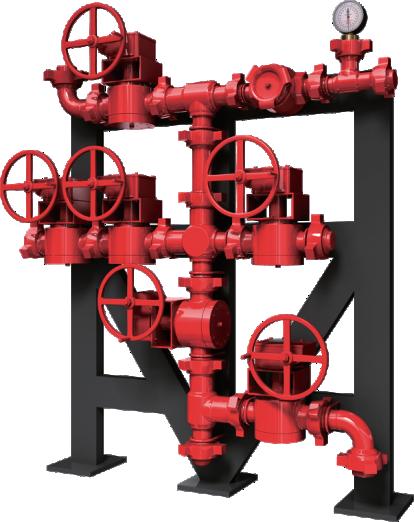
Full‑Bore Gate Valves with Metal Seats:We use API 6A slab or expanding gate valves (manual or actuated) for manifold isolation. The seats are stellite‑faced and live‑loaded to maintain seal under pressure and temperature cycles. No elastomers to blow out – metal seals only, rated to 20,000 psi.
-
Hardened Flow Tees & Crosses:In a choke manifold, the flow turns multiple times. Each turn is an erosion hotspot. We apply induction‑hardened bores (HRC 55‑60) to a depth of 3 mm on all flow‑through tees and cross fittings. Erosion life is 5× standard steel.
Products
Drilling Fluid Manifold
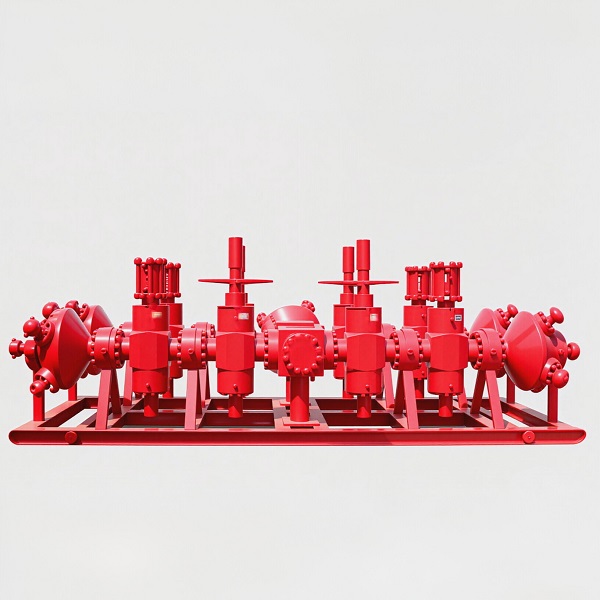
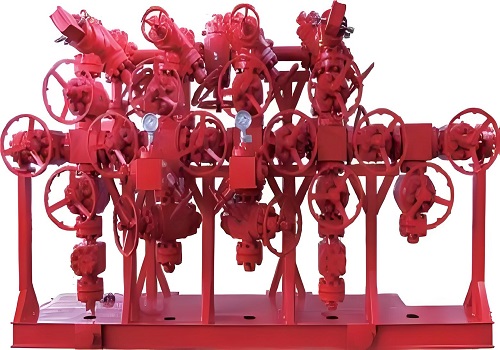
Technical Specifications (Choke Manifold – 10,000 psi, 4″ flow line)
Below is a typical 10,000 psi choke manifold for land or offshore rigs. Custom configurations available.
| Parameter | Specification |
|---|---|
| Pressure Rating | 10,000 psi (69 MPa) – also 5k, 15k |
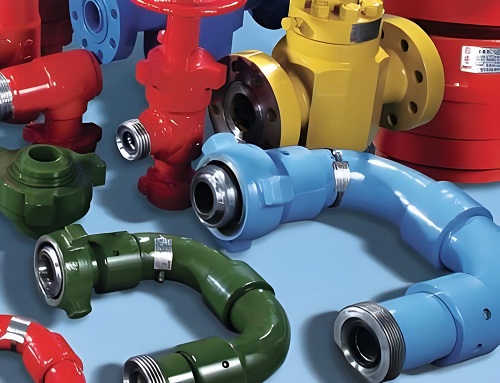
| Flow Line Size | 3″ or 4″ nominal bore (hammer‑union or flanged) |
| Number of Chokes | 2 (primary + secondary) – single or dual adjustable |
| Choke Type | Adjustable needle & seat (stelite) – hydraulic or manual |
| Choke Trim | Stellite 6 (HRC 55‑60) – replaceable seat |
| Isolation Valves | API 6A slab gate valves (metal seat, live‑loaded) |
| Valve Actuation | Manual handwheel (std) – optional hydraulic or pneumatic |
| Gauges | Upstream & downstream pressure (4.5″ dial, glycerin filled) |
| Temperature Sensors | Optional RTD or thermowell on outlet |
| Downstream Connection | Flanged or hammer‑union to mud gas separator / flare |
| Material (Wetted) | AISI 4130 (NACE MR0175) – 22Cr duplex optional |
| Erosion Protection | Induction‑hardened tees & crosses (HRC 55‑60) |
| Skid Dimensions (L×W×H) | 3 m × 1.8 m × 1.8 m (10 ft × 6 ft × 6 ft) – typical |
| Skid Weight | 2.5 – 4 tonnes (depending on components) |
| Remote Control | Hydraulic with panel – includes ESD and position feedback |
| Pressure Test (Shop) | Hydrostatic: 1.5× rated pressure (15,000 psi) |
| Valve Cycle Life | 1,000+ cycles at rated pressure |
| Certifications | API 6A, API 16C, API Q1, NACE MR0175 |
| Operating Temperature | –29°C to +121°C (with appropriate seals) |
Application Fields
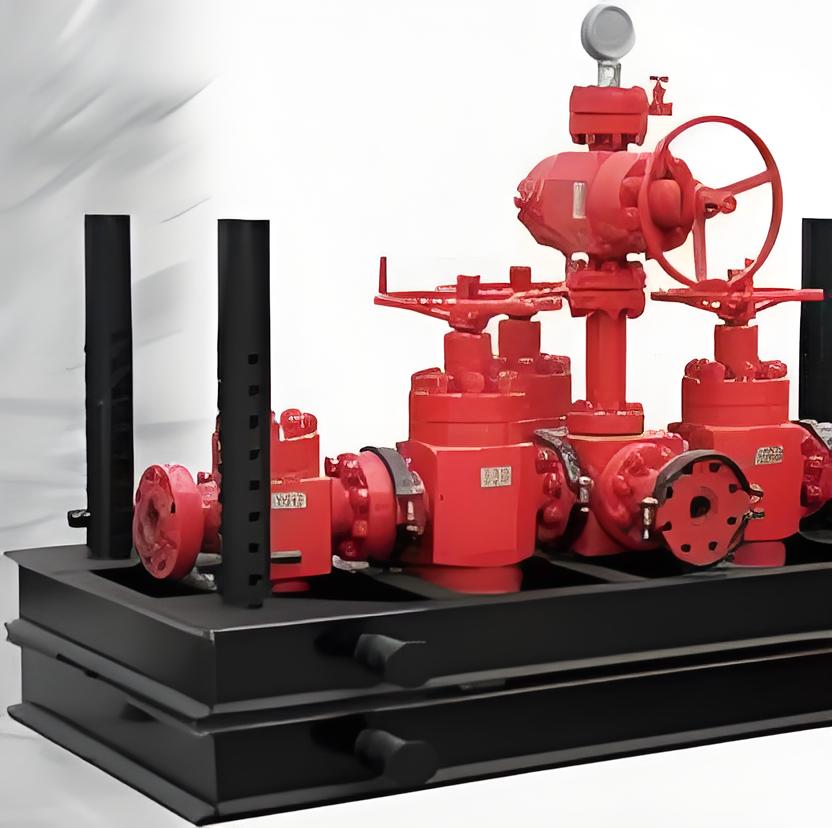
Drilling fluid manifolds are used on every type of drilling rig where well control and circulation are required.
-
Onshore Drilling Rigs
From shallow water wells (5,000 psi) to deep gas wells (15,000 psi), our choke and kill manifolds are installed on the rig substructure. They are rigged up once and remain for the entire well. Our modular skid design fits inside a standard 20‑ft shipping container for transport. -
[Image Placeholder: Choke manifold skid installed on an onshore rig substructure]
Offshore Jack‑Up & Platform Rigs
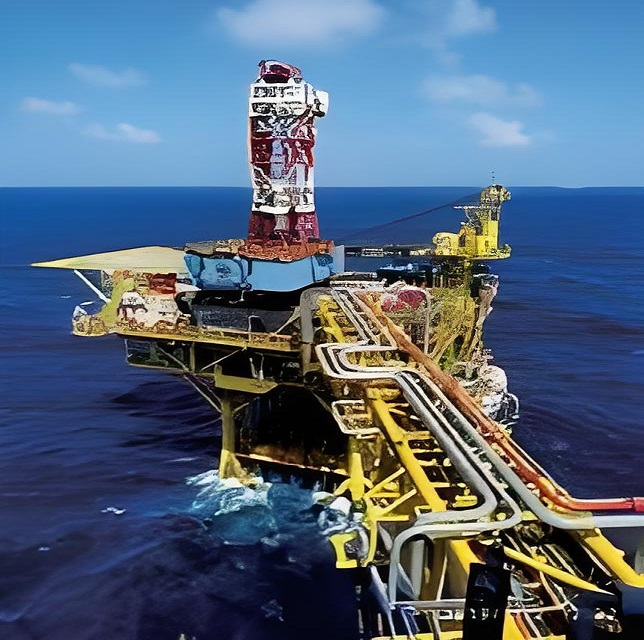
Space is tight offshore. Our compact single‑skid combination choke & kill manifold fits in a 3 m × 2 m footprint. All valves are remotely actuated from the driller’s cabin – no manual intervention at the manifold. -
Managed Pressure Drilling (MPD) Systems
MPD requires precise backpressure control. Our chokes are equipped with high‑speed actuators (response < 0.5 seconds) and flow‑characterized trim. We have supplied MPD manifolds to several deepwater and land MPD projects. -
Well Control Training Simulators
Drilling schools use smaller, low‑pressure choke manifolds (2,000–5,000 psi) to train crews on kick circulation procedures. We supply scaled‑down versions with transparent choke housings for educational use. -
Workover & Snubbing Rigs
When snubbing under pressure, a small choke manifold (2″ flow line, 10,000 psi) is used to bleed off pressure while stripping pipe. Our compact "workover choke manifold” is a popular item for snubbing service companies.
Why Choose SJ Petroleum Machinery for Drilling Fluid Manifolds?
1. Erosion Resistance You Can Trust
Abrasive mud (weighted with barite, often containing drilled solids) cuts through standard steel chokes and fittings in weeks. Our induction‑hardened bores and stellite choke seats last 5× longer. Many operators report finishing an entire well (6 months) without changing a choke seat.
2. Smooth, Predictable Choke Characteristics
Some chokes have a "on/off” characteristic – a small turn of the handle changes pressure drop dramatically. Our needle/seat geometry is linearized for precise control. The driller can dial in any casing pressure from 0 to 100% of rating with fine resolution.
3. Remote Operation = Safer Drilling
No one should stand next to a choke manifold during a kick. Our hydraulic remote control system allows the driller to operate all chokes and valves from the driller’s console, 50 meters away. Automatic "close on hydraulic failure” ensures failsafe.
4. Built to API 16C – The Drilling Manifold Standard
API 16C covers choke and kill systems. We hold the license. Our manifolds meet all requirements for pressure ratings, materials, testing, and documentation. No "designed to API” – we are certified.
5. Complete Data Book for Compliance
Regulators and operators demand full traceability. Each manifold comes with a bound data book containing: material test reports (MTR) for every forging, weld maps and X‑ray reports, pressure test charts (body and seat), NDE reports (MT, UT), and valve/choke serial number logs.
6. Global Service & Spares
We stock choke seats, valve seats, seals, and complete spare chokes in Houston, Dubai, Singapore, and Jingzhou. On‑site service teams can perform choke seat replacement or valve repair without removing the manifold from the rig.
Frequently Asked Questions (FAQ)
Q1: What is the difference between a choke manifold and a kill manifold?
A choke manifold is on the "outlet” side of the well – it bleeds off pressure from the annulus during a kick, directing flow to the mud gas separator or flare. A kill manifold is on the "inlet” side – it allows the mud pumps to pump heavy kill mud into the well below the BOP rams. Both are essential for well control.
Q2: How many chokes do I need on a choke manifold?
API recommends at least two independent chokes (primary and secondary) in series. If one plugs or erodes, you switch to the other without losing pressure control. Many rigs have two adjustable chokes plus a fixed orifice (positive) choke as a third option.
Q3: Can your manifold handle high‑pressure gas kicks (15,000 psi)?
Yes – we offer 15,000 psi rated manifolds (API 16C Class 15). The choke seat is stellite, and all valves are metal‑sealed. The body is forged 4130 and hydrotested to 22,500 psi. We have supplied 15k manifolds to deep gas wells in the Middle East and Sichuan.
Q4: How do I know when a choke seat needs replacement?
If you cannot maintain stable casing pressure (pressure fluctuates with choke position unchanged), or if the choke leaks through when fully closed, the seat is worn. Also, if you see a steady increase in downstream pressure with the choke closed, replace the seat. We provide seat wear gauges for field checking.
Q5: Do you provide remote actuation for all valves, or just the chokes?
We can actuate any valve on the manifold – isolation gates, bypass valves, and chokes. Most customers actuate the chokes and one isolation valve per side, leaving the other valves manual. For fully remote operation, we add hydraulic actuators on all valves with a centralized control panel.
Q6: Can the manifold be used for both drilling and well testing?
Yes – many of our manifolds are dual‑service. For well testing, the choke manifold routes flow to a test separator instead of the mud gas separator. The pressure rating is the same. However, for permanent drilling service, we recommend not swapping in/out components too often – it increases leak potential.
Q7: What is the typical lead time for a custom choke manifold?
Standard configurations (2‑choke, 3‑valve, 10,000 psi, manual) – 8–10 weeks. With remote actuation and customized skid layout – 12–14 weeks. For rush orders, we may have a rental or stock unit available.
Q8: Do you offer manifolds with electric actuators (for MPD)?
Yes – for MPD we supply electric actuators with position feedback and fast response (0–100% stroke in < 1 second). The control system can be integrated with MPD automation software via Modbus or Ethernet/IP.
Q9: How should I winterize the manifold for cold climates (‑30°C)?
We offer: (1) heat tracing with insulation (electric or steam), (2) low‑temp seals (FKM or AFLAS instead of HNBR), (3) heated control panel enclosure, (4) dry nitrogen purging of hydraulic lines. Specify "winterization” when ordering.
Q10: Do you provide installation and commissioning support?
Yes – included for first‑time buyers. Our field engineer travels to your rig, supervises skid placement, connects hydraulic/control lines, and performs a full function test with the driller. We also train your crew on choke seat replacement and valve maintenance. For remote offshore sites, we provide virtual commissioning via video link.
Tag: Offset drilling technology | Offset drilling services | Offset drilling solutions | Synchronous drilling system | Synchronous drilling technology | Advantages of synchronous drilling | Synchronous drilling solutions | Low temp drilling technology | Low temp rig specifications | Low temp drilling solutions | Fast Repair and Fast Installation Drilling Rig / Big Easy Series
Previous:
Fracturing Manifold
Send Inquiry