Technical Specifications
| Parameter | SJ-200 (Light Cementing) | SJ-400 (Standard Cementing) | SJ-600 (Heavy Cementing/Liner Jobs) |
|---|---|---|---|
| Max Input Horsepower | 200 HP | 400 HP | 600 HP |
| Max Flow Rate (typical) | 600 L/min @ 2,500 psi | 1,200 L/min @ 2,500 psi | 1,800 L/min @ 3,000 psi |
| Max Working Pressure | 3,500 psi (adjustable relief) | 4,000 psi (adjustable) | 5,000 psi (adjustable) |
| Pump Type | Triplex single-acting | Triplex single-acting | Triplex or Quintuplex |
| Plunger Diameter Options | 3", 3-3/4", 4" | 4", 4-1/2", 5" | 5", 5-1/2", 6" |
| Fluid Handling | Fresh water, spacer, cement slurry | Same + weighted fluids | Same + high-density cement |
| Discharge Connections | 2" Fig 1502 hammer unions | 3" Fig 1502 | 3" or 4" Fig 1502 |
| Suction Connection | 4" camlock or flanged | 6" camlock or flanged | 6" camlock or flanged |
| Drive Options | Diesel or 150 HP electric | Diesel or 300 HP electric | Diesel or 500 HP electric |
| VFD Compatible | Yes (electric version) | Yes (electric version) | Yes (electric version) |
| Skid Dimensions (L×W×H) | 3.2m × 1.8m × 1.6m | 3.8m × 2.0m × 1.8m | 4.5m × 2.2m × 2.0m |
| Dry Weight | 3,200 kg | 5,500 kg | 8,000 kg |
| Relief Valve Setting | Field-adjustable 500–3,500 psi | Field-adjustable 500–4,000 psi | Field-adjustable 500–5,000 psi |
| Certifications | API Spec 7K, ISO 9001, CE | API Spec 7K, ISO 9001, CE | API Spec 7K, ISO 9001, CE |
Application Fields
Primary Cementing Backup. Standby pump alongside your main cementing unit. If the primary unit fails during a critical job, SJ’s pump takes over displacement without losing circulation. This is standard practice for deep wells or high-cost offshore (though this is land-focused, the same principle applies).
Spacer & Pre-Flush Pumping. Pumping water-based spacers, chemical washes, or viscous sweeps ahead of cement. SJ’s pump handles the full range of spacer viscosities and densities.
Displacement After Cement Placement. Once cement is in place, you need to displace the plug with drilling fluid or water. SJ’s pump provides precise displacement rates to avoid fracturing weak formations or under-displacing the plug.
Batch Mixing Support. When using a central batch mixer to prepare cement slurry off-site, SJ’s pump transfers the mixed slurry from the batch tank to the wellhead—eliminating the need for a separate transfer pump.
Fluid Loss Control Pill Spotting. Some cementing jobs require spotting a viscous fluid loss control pill across a permeable zone before cement. SJ’s pump accurately places small volumes (5–20 bbl) at controlled rates.
Casing Pressure Testing. After cement sets, you need to pressure-test the casing. SJ’s pump with fine throttle control can slowly ramp up pressure to test value (e.g., 3,000 psi) and hold for the required duration.
Squeeze Cementing (Small Volume). For remedial squeeze jobs, you often pump small volumes of cement through a coiled tubing unit or drill pipe. SJ’s smaller model (200 HP) is ideal for these low-flow, high-pressure applications.
Rigid Casing Running Fill-Up. When running long casing strings, you fill the casing periodically with drilling fluid to manage buoyancy. SJ’s pump provides high-volume, low-pressure fill quickly.
Why Choose SJ?
Sinopec Engineering Heritage Meets Cementing Specialization. SJ is a wholly-owned subsidiary of Sinopec Group—one of the world’s largest oilfield service and manufacturing entities. But unlike general-purpose pump builders, SJ has decades of cementing-specific experience from supporting Sinopec’s own cementing fleets. We know the difference between a pump that "can handle cement” and one that’s built for it.
API 7K + Cementing-Ready Features. API Spec 7K covers drilling pump design, but SJ goes further: abrasion-resistant fluid end options, lower-range relief valves, suction manifold sized for viscous fluids, and documentation packages tailored for cementing service companies.
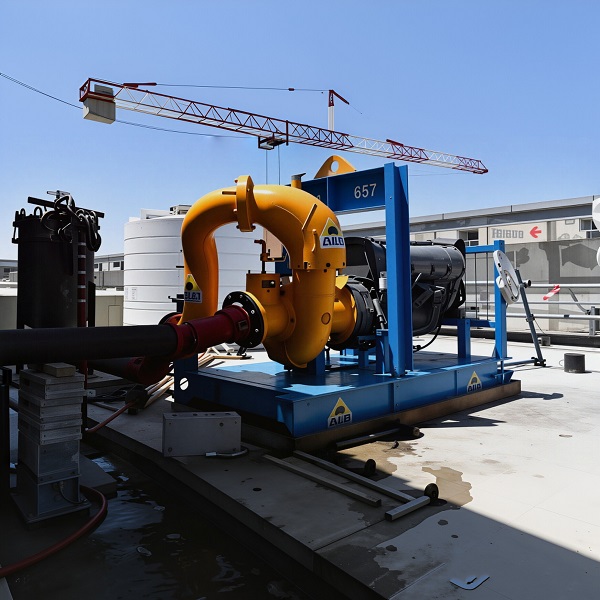
Compact Skid, Big Performance. Many cementing support pumps are just bare pumps bolted to old drill rig skids—oversized and awkward to rig. SJ’s skid is purpose-designed for cementing: everything within a 4m × 2m footprint, lifting points rated for helicopter or crane, and all valves/hoses accessible from ground level without climbing.
OEM Replacement for Worn Fleet Pumps. If your existing cementing support pump (e.g., old Gardner Denver, Halliburton skid pump, or National pump) is worn out or beyond repair, SJ can build a direct replacement—same mounting footprint, same discharge centerline height, same suction location. You swap skids in a day, reuse existing hoses and manifolds.
Global Support for Cementing Contractors. SJ has supplied cementing equipment to international oilfields in the Middle East, Central Asia, Southeast Asia, and South America. Our export team provides English manuals, remote troubleshooting, and parts shipment within 72 hours for critical failures.
Factory Witness Testing. Before shipment, SJ runs a full performance test on your specific pump at our Jingzhou facility—pressure, flow, vibration, temperature. You can attend in person or watch a live video feed. We provide a signed test report with every pump.
Three-Level Customization. Tell us your well conditions: maximum displacement pressure, required flow rate, fluid types (fresh water only? weighted spacer? cement slurry?), power availability (diesel or electric). SJ engineers size the plungers, select the relief valve range, and configure the suction manifold accordingly. No one-size-fits-all.
Frequently Asked Questions (FAQ)
Q1: What exactly is "cementing support,” and why do I need a dedicated pump for it?
Cementing support means pumping fluids that aren’t the main cement slurry itself—like spacers, pre-flushes, displacement fluid, or providing backup pressure if your main cementing unit fails. You need a dedicated support pump because (a) your primary cementing unit might be busy mixing cement, (b) two pumps give redundancy on critical jobs, and (c) a small skid pump is cheaper and easier to move than a full cementing truck.
Q2: Can this pump actually pump cement slurry, or just water and spacers?
SJ’s pump can pump cement slurry directly, but with caveats: cement is highly abrasive and will wear out valves, seats, and packing faster than water. For occasional direct slurry pumping (e.g., small squeeze jobs), SJ offers abrasion-resistant fluid end upgrades. For continuous slurry pumping, we recommend a dedicated cementing unit. For displacement of already-placed cement, the pump sees clean fluid only and lasts much longer.
Q3: How do I control the pump rate for precise displacement?
Electric-drive versions with a VFD give the best control—turn a dial from 0% to 100% speed. Diesel versions use a hand throttle on the engine or a remote control cable. Both allow smooth acceleration and deceleration. SJ does not recommend clutch-bump starts for displacement—too jerky.
Q4: What pressure relief valve setting should I use for cementing?
It depends on your casing burst pressure and formation fracture gradient. As a rule: set relief 10–20% above your planned maximum pumping pressure, but never above casing burst rating. A typical shallow well (1,500m) might use 2,500 psi. A deep liner (4,500m) might use 5,000 psi. SJ provides adjustable valves from 500 to 5,000 psi—your field supervisor sets the final value.
Q5: How portable is the skid? Can I move it without heavy equipment?
Skids under 400 HP weigh under 6,000 kg. A flatbed truck with a crane or a rough-terrain forklift can move it. SJ includes four fork pockets and four lift eyes rated for the skid’s gross weight. For remote locations without heavy equipment, SJ offers a "roller skid” option with removable pipe rollers—you can winch it onto a lowboy trailer.
Q6: Do you provide hoses and manifolds with the pump?
SJ can include suction and discharge hoses (2” to 4”, rated to working pressure), camlock or hammer union adapters, and a basic manifold with valves. The standard package includes the pump, pulsation dampener, relief valve, and skid piping up to the discharge connection flange. Hoses and site-specific manifolds are optional add-ons.
Q7: What training do you offer for cementing crews?
SJ provides a half-day on-site training covering: pump startup/shutdown, daily inspection points, packing adjustment, valve/seat replacement, pulsation dampener charging, and emergency shutdown procedures. We can also include basic cementing hydraulics (how to calculate displacement volumes and rates). Training is available in English or with a translator.
Q8: What’s the typical lead time for a cementing support pump?
Catalog models with stock components (SJ-200 or SJ-400 diesel drive, standard fluid end) ship in 20–30 days. Custom orders (specific plungers, electric VFD package, special coatings) take 45–60 days. Emergency replacement pumps (matching your existing footprint) can sometimes be expedited to 15 days—contact us with your timeline.
Q9: Can I rent a pump before buying?
SJ does not offer direct rental, but we can refer you to rental partners in key markets (North America, Middle East, Southeast Asia) who maintain SJ pumps in their fleets. Many customers rent first to validate performance, then purchase.
Q10: How do I request a quote for my cementing program?
Send SJ’s sales team the following: (1) Maximum cementing depth (meters or feet), (2) Largest casing size to displace, (3) Planned maximum pump pressure (psi or bar), (4) Desired flow rate (GPM or L/min), (5) Power source available (diesel on site, generator, or grid). We’ll respond with a pump recommendation, datasheet, dimensional drawing, price, and delivery estimate within 48 hours.