Technical Specifications
| Parameter | Twin-Pump Offshore Cementing Skid |
|---|---|
| Configuration | Twin skid (pump + mixing) or integrated single skid |
| Drive Options | Diesel engine (explosion‑proof) / AC electric (Ex d) |
| Pump Type | Two triplex single‑acting plunger pumps |
| Max Discharge Pressure | Up to 103.5 MPa (15,000 psi) |
| Max Discharge Rate | Up to 4.5 m³/min (approx. 28 bpm) |
| Slurry Density Range | 1.3 – 2.5 g/cm³ (10.8 – 20.9 ppg) |
| Density Control Accuracy | ±0.02 g/cm³ (±0.17 ppg) |
| Dry Bulk Capacity (optional silo) | Up to 60 m³, vertical configuration |
| Liquid Additive System | Up to 6 chemical streams, direct‑injection |
| Mixing System | Recirculating / automatic batch mixing |
| Control System | PLC‑based with HMI, remote operation capable |
| Pump Plunger Sizes | 3.0″, 3.5″, 4.0″, 4.5″ (interchangeable) |
| Skid Dimensions (L×W×H) | Approximately 7,000×2,500×2,600 mm (configurable) |
| Dry Weight (full skid) | Approximately 25,000 – 32,000 kg |
| Certifications | API Q1, ISO 9001:2015; ABS/DNV/Lloyds (optional) |
| Standard Inclusions | Slurry mixing tank, displacement tank, remote control cabin, pressure recorder |
| Optional Accessories | Vertical cement silo, water tank skid, manifold trailer, telemetry system |
Key Applications
TLP Permanent Well Cementing
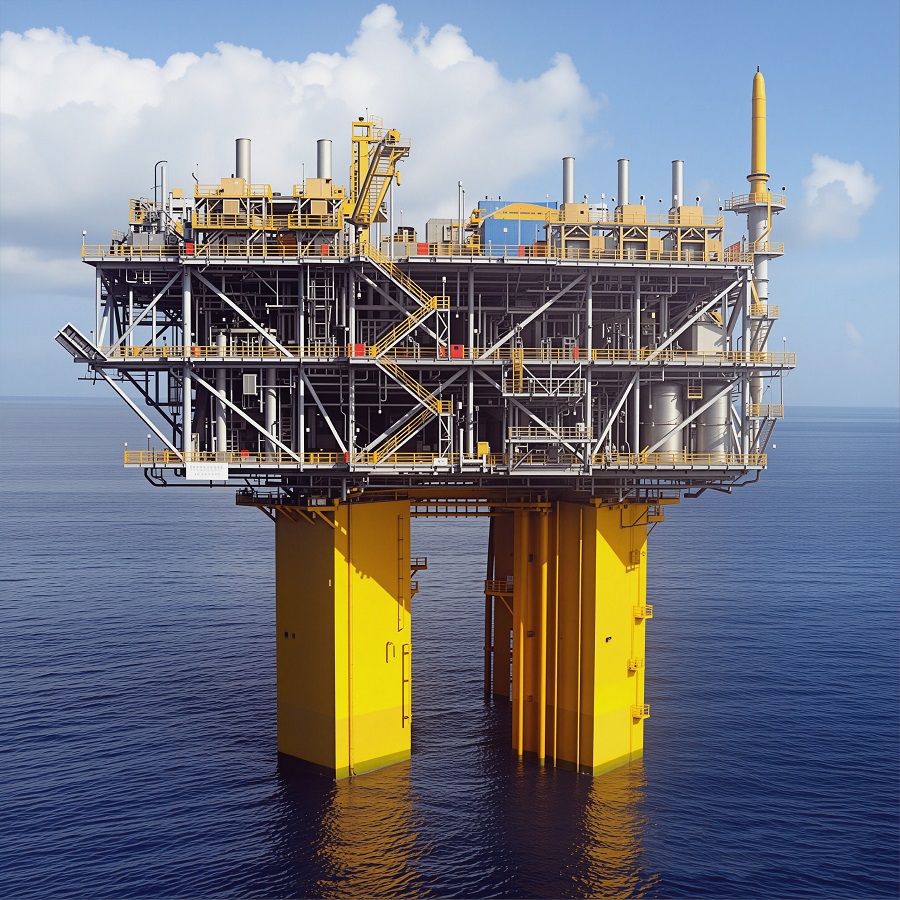
During TLP installation, the wells are typically batch‑set and cemented from the platform deck after the topside is floated over and secured. Our cementing skid provides the on‑deck mixing and pumping capability for both surface casing and production casing strings. The twin‑pump configuration ensures continuous slurry delivery even if one pump requires maintenance during the job, a critical reliability feature when cementing strings that run thousands of meters into the subsea wellhead.
Deepwater Shallow Hazard Cementing
TLPs are often positioned in deepwater basins where shallow hazards—gas hydrates, shallow water flow zones, and unconsolidated sands—present significant drilling risks. Lightweight trimodal cement blends are frequently required to achieve zonal isolation without fracturing weak formations. Our automated density control system maintains the precise, low densities needed for these applications while delivering the high displacement rates that deepwater batch‑set operations demand.
Annular Squeeze and Remedial Cementing
Even with careful primary cementing, production wells on TLPs may develop annular communication or sustained casing pressure over time. Remedial squeeze cementing through perforations often requires lower pump rates but higher pressures than primary jobs. The precise rate control and high‑pressure capability of our twin‑pump configuration make it suitable for both functions from a single skid.
TLP Tendon Cementing Repair
Although TLPs are tensioned by mechanical tendons rather than cement, there are scenarios where cementing is required for tendon foundation anchors or for repairs following tendon damage. Our equipment's compact footprint can be positioned near the platform's tendon porches, while the pumping system handles the sometimes corrosive seawater‑based slurries used in subsea foundation work.
Production Platform Back-Up and Multi‑Purpose Pumping
Beyond cementing, TLP operators often use the same equipment for pressure testing of production equipment, chemical injection line flushing, and acid stimulation of nearby subsea wells accessed from the platform deck. The twin‑pump design serves effectively as a general‑purpose high‑pressure pumping skid, reducing the need to maintain separate equipment inventories.
Well Abandonment and Decommissioning
At the end of a TLP's productive life, wells must be permanently abandoned with cement plugs placed across all hydrocarbon zones. Our cementing skid remains on deck for this final campaign, providing the same reliable service it delivered during installation decades earlier.
Why Choose SJ Petroleum Machinery?
A Sinopec Subsidiary with Deep Offshore Capability
SJ Petroleum Machinery is a wholly‑owned subsidiary of Sinopec Oilfield Equipment Corporation (SOFE). We have delivered offshore cementing equipment to platforms across the South China Sea, Bohai Bay, Middle East, and Southeast Asia. Our product portfolio spans drilling rigs, fracturing units, offshore drilling and production equipment, and high‑pressure fluid control products, across more than 200 models in four major categories.
Designed for TLP Operations, Not Just Adapted from Land Units
Rather than repurposing land cementing units with extra paint, our offshore equipment begins with platform‑specific design requirements: compact footprint to fit tight TLP decks, explosion‑proof electricals for hazardous production areas, saltwater corrosion protection, and simplified maintenance access for offshore crews with limited heavy tooling.
Automated Slurry Control for Deepwater Reliability
Deepwater TLP cementing demands precision that manual mixing cannot guarantee. Our fully automated mixing system, with inline density measurement and PLC control, maintains slurry properties within tight tolerances across the full pumping range. This reduces the risk of incomplete displacement, channeling, or lost circulation—common failure modes for poorly designed cement jobs.
Full Integration with TLP Deck Facilities
We don't just ship a skid. Our engineering team works with your platform designers to integrate the cementing unit with deck power (AC or DC), potable and seawater systems, dry bulk storage, and control room interfaces. For retrofit installations, we can modify our skid dimensions and connection points to match existing deck layout without major structural changes.
Global Logistics and Offshore Service Support
With over two decades of export experience, we know how to move oversized equipment to offshore staging ports efficiently. Sea‑worthy crating, complete documentation, and coordination with your logistics provider are included as standard. We maintain regional service hubs and can deploy field service engineers to your platform for commissioning and crew training.
Cost‑Effective Without Compromising Specifications
Compared to the established European and North American brands, our offshore cementing skids typically offer 20–30% lower capital cost while meeting or exceeding the same API and classification society requirements. This cost advantage comes from efficient manufacturing and supply chain control—not from cutting corners on materials, testing, or safety features.
Frequently Asked Questions (FAQ)
Q1: What makes TLP cementing different from cementing on a fixed platform or semisubmersible?
Three primary differences. First, TLP deck space is extremely limited because the platform is designed to minimize structural weight—every square meter carries a premium. Our equipment’s compact footprint addresses this directly. Second, TLP wells are typically cemented during initial platform installation, with minimal opportunity for re‑entry later. That means your equipment must be absolutely reliable for those first critical jobs. Third, while TLPs have minimal heave, there is still residual motion that must be considered in equipment securing and hose management.
Q2: Can your cementing skid be operated from an onshore remote center?
Yes. Our PLC‑based control system can be configured for remote operation via satellite or fiber optic link. The offshore unit accepts commands from an onshore HMI while transmitting real‑time data including pump rates, pressure, density, and additive rates. This functionality aligns with industry trends toward automated cementing, as demonstrated by Halliburton's LOGIX service across hundreds of offshore jobs with zero safety incidents and SLB’s fully automated offshore cementing.
Q3: What are the lead times for an offshore cementing skid?
Standard configurations (diesel drive, twin pump, carbon steel fluid ends, non‑classified electricals): 8–10 months EXW from order confirmation. Classified units (ABS/DNV, explosion‑proof, specialized metallurgy): 10–12 months. Rush orders possible for simplified configurations or if we have test units in production.
Q4: How does your mixing system maintain density accuracy in lightweight cement blends?
Lightweight blends (density below 1.8 g/cm³) are notoriously difficult to mix consistently because air entrainment and additive distribution vary with pump rate. Our system uses a recirculating mixing method with a high‑shear jet mixer, followed by an inline densitometer that provides continuous feedback to the PLC. The controller automatically adjusts the mixing water and additive injection rates at sub‑second intervals. Field data shows density held within ±0.02 g/cm³ across flow variations from 0.5 to 3.0 m³/min.
Q5: Are your units certified for explosive atmosphere zones?
Yes. We offer two explosion‑proof packages:
-
Electric drive: Motors with Ex d (flameproof) enclosures, intrinsically safe instrumentation, and sealed junction boxes. Rated for Zone 1, IIB+H2 gas groups.
-
Diesel drive: Flame arrestors on air intakes, spark arrestor exhaust, automatic shutdown systems, and surface temperature controls. Suitable for Zone 2.
Third‑party certification (ATEX, IECEx, or local equivalents) is available as a chargeable option.
Q6: What is the typical lifespan of consumables in offshore service?
Based on actual field data from deepwater cementing campaigns:
-
Valves and seats: 400–800 pumping hours (depending on slurry abrasiveness)
-
Plunger packing: 200–400 hours
-
Fluid end liners: 800–1,500 hours
We recommend keeping a full set of these consumables on the platform for the duration of your drilling or workover campaign. Spare parts are stocked in our Houston, Dubai, and Shanghai hubs for air freight within 3–5 days.
Q7: Can the skid be split into smaller modules for easier deck installation?
Yes. For platforms with limited crane capacity or tight access routes, we offer split‑skid configurations. The pumping module, mixing module, control cabin, and bulk storage silos are all designed for separate transport. Each module weighs under 15 metric tons, well within the lift capacity of typical platform cranes. Field reassembly is straightforward with the included fit‑up guides and hydraulic connections.
Q8: What certifications do you provide with the equipment?
Each unit ships with a full documentation package including:
-
API Q1 certificate of compliance
-
Material test reports for all pressure‑containing components
-
NDE reports (magnetic particle, ultrasonic, dye penetrant as applicable)
-
Hydrostatic test records
-
As‑built dimensional drawings
-
Electrical schematics and PLC logic printouts
-
Factory acceptance test (FAT) report witnessed by your inspector if arranged
Third‑party verification for ABS, DNV, or Lloyds classification is available at additional cost.
Q9: What is your warranty and after‑sales support?
18 months from shipment or 12 months from commissioning, whichever occurs first. We maintain a 24/7 technical support hotline for offshore clients. For the first cementing campaign, we recommend having one of our field service engineers on‑site for commissioning and crew training (fees apply for travel and daily rate). Remote troubleshooting via video link is always provided at no charge.
Q10: How do I get a technical proposal for my TLP project?
Please provide the following information to our offshore sales engineering team:
-
TLP water depth and location
-
Intended application (primary cementing, remedial, or both)
-
Required pump pressure and flow rate
-
Deck space available (length × width)
-
Power availability (diesel, AC voltage/frequency, or both)
-
Desired certification (none, ABS, DNV, Lloyds)
-
Preferred delivery timeline
We will respond within 5 business days with a formal quotation, preliminary 3D model, and technical datasheet tailored to your project.