-
True Seamless Construction (Not ERW or Welded):Every pipe is manufactured from solid billet using the pierce‑and‑draw process (hot rolling) or forged from bar stock for larger diameters. No longitudinal weld seam – the primary failure point in cheaper pipes. We supply only seamless.
-
Full Body Normalize & Temper Heat Treatment:After forming, the pipe undergoes a full heat treatment cycle (normalize, quench, temper) to achieve uniform grain structure and consistent hardness (typically 22–28 HRC for 4130). This eliminates residual stresses and ensures predictable burst strength.
Products
High-Pressure Straight Pipe
Product Types
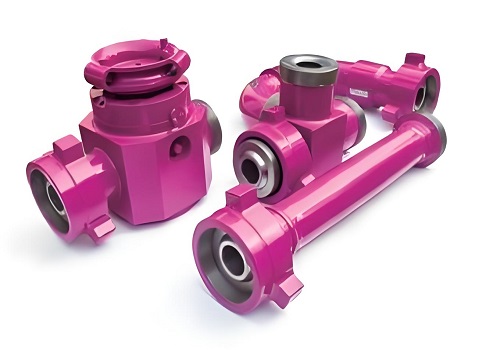
We offer three main families of high‑pressure straight pipe, based on end connection and service.
| Product Type | End Connections | Pressure Rating | Typical Use |
|---|---|---|---|
| SJ‑PHP (Hammer‑Union Pipe) | Fig 1502 / 2002 / 2202 – both ends | 10k – 20k psi | Fracturing, cementing, coil tubing – rapid connect/disconnect |
| SJ‑PFP (Flanged Pipe) | API 6A flanges (weld neck or integral) | 5k – 20k psi | Production manifolds, wellhead flowlines, permanent installations |
| SJ‑PBT (Butt‑Weld Pipe) | Beveled ends for field welding | 10k – 20k psi | High‑temperature or permanent pipeline connections – no threaded leak paths |
Within each type, we offer standard lengths (3 m, 6 m, 9 m, 12 m) and custom lengths (minimum 0.5 m). Wall thicknesses from Schedule 160 up to XXS (double extra strong).
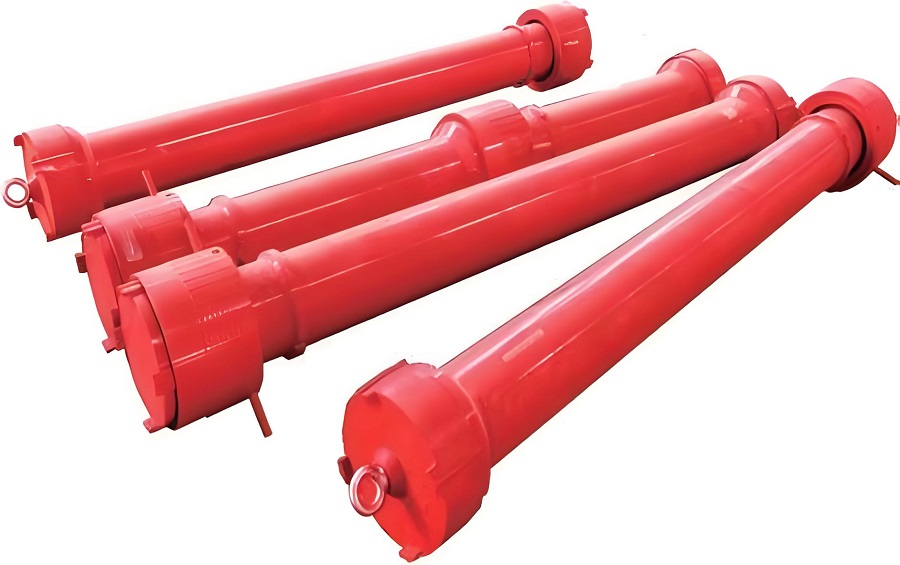
For fracturing fleets, the most common is SJ‑PHP (Fig 1502, 15,000 psi, 2″ or 3″ pipe, 6 m or 9 m length). We keep these in stock for same‑day shipment.
Technical Specifications (SJ‑PHP, 15,000 psi, Fig 1502)
Below is our standard high‑pressure straight pipe for fracturing and well testing.
| Parameter | Specification |
|---|---|
| Pressure Rating | 15,000 psi (103.5 MPa) – also 10k and 20k |
| Pipe OD (Nominal) | 2″ (60.3 mm) or 3″ (88.9 mm) |
| Wall Thickness | 10.5 mm (2″) / 12.0 mm (3″) – schedule 160 |
| Inside Diameter | 39.3 mm (2″) / 64.9 mm (3″) |
| Material | Forged AISI 4130 (chrome‑moly), normalized & tempered |
| Yield Strength (min) | 620 MPa (90 ksi) |
| Tensile Strength (min) | 730 MPa (106 ksi) |
| Hardness | 22 – 28 HRC (NACE compliant) |
| Elongation | 16% (min) |
| End Connections | Fig 1502 (2″) or Fig 2002 (3″) male / female hammer‑union |
| Length (Standard) | 3 m, 6 m, 9 m, 12 m (± 50 mm) |
| Length (Custom) | 0.5 m to 12 m in any increment |
| Straightness | 1 mm per meter (max) |
| Surface Finish | Mill scale removed – optional painting (yellow, red, or custom) |
| Non‑Destructive Testing | 100% UT (longitudinal and transverse), MT on connections |
| Hydrostatic Test | 1.5× rated pressure – 22,500 psi (155 MPa), 30 sec hold |
| Traceability | Heat number stamped on each pipe + MTR provided |
| Certifications | API 6A, API 16C, ISO 13533, NACE MR0175 |
| Weight (6m length, 2″ pipe) | Approximately 95 kg (210 lbs) |
| Working Temperature | –29°C to +121°C (standard) – higher with special elastomers in hammer union seals |
Application Fields
High‑pressure straight pipe is the workhorse of surface high‑pressure fluid transfer.
-
Hydraulic Fracturing Manifolds
The frac manifold connects pump discharge to wellhead. Straight pipe sections (typically 6–12 m) with Fig 1502 hammer unions are laid out between the main manifold and each wellhead. Over 1 million feet of our pipe has been used in Permian, Sichuan, and Vaca Muerta frac spreads. -
[Image Placeholder: Frac manifold with rows of straight pipe connecting pumps to wellheads]
Well Testing & Flowback
From wellhead to test separator, choke manifold, and flare stack – straight pipe sections with flanged or hammer‑union ends are assembled into temporary flowlines. Our lightweight 2″ pipe is easy for crews to handle. -
Cementing Lines
Cementing pumps discharge at 5,000–10,000 psi through steel pipe. We supply 3″ Fig 1502 straight pipe (9 m lengths) with a smooth ID to reduce friction pressure and prevent cement settling. -
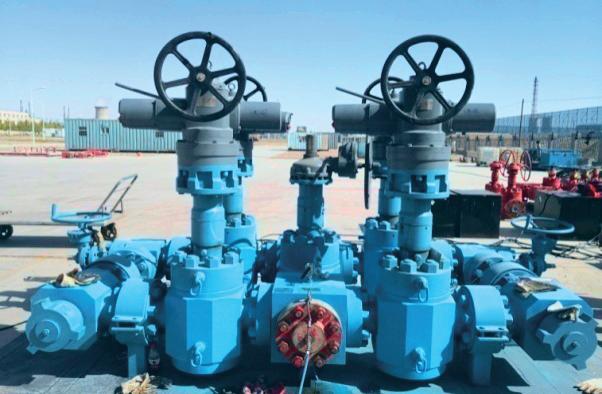
Production Manifolds (High Pressure)
Permanent manifolds on high‑pressure gas wells often use flanged straight pipe sections bolted together. Our API 6A flanged pipe is supplied ready for field installation – no cutting or welding required. -
Acidizing & Chemical Injection Lines
For acid stimulation or continuous chemical injection, we supply 13Cr or 22Cr duplex pipe with threaded or hammer‑union ends. The material resists corrosive acids (HCl, HF). -
Snubbing & Coiled Tubing Support Lines
Hydraulic power units for snubbing jacks need high‑pressure supply and return lines. Our compact 1‑1/2″ pipe (10,000 psi) with NPT threads is used for these fixed installations.
Why Choose SJ Petroleum Machinery for High‑Pressure Straight Pipe?
1. API 6A and API 16C Licensed – Not "Equivalent”
We hold API 6A (wellhead equipment) and API 16C (surface choke and kill) licenses. Our pipes are built to the same standard as any major brand. Third‑party inspectors welcome.
2. 100% Seamless + 100% Tested
No seamed pipe. No skip testing. Every single pipe is ultrasonically inspected, magnetic particle inspected on ends, and hydrostatically proofed. We reject about 2% of raw pipe from our mills – you get only the good ones.
3. Full Traceability for Every Inch
Each pipe gets a unique serial number. We store UT charts, hydro test curves, and MTRs for 20 years. If you ever have a failure, we can reconstruct the entire manufacturing history.
4. Fast Turnaround – Stock on Common Sizes
We maintain an inventory of 2″ and 3″ Fig 1502 pipe in 3m, 6m, and 9m lengths in Houston, Dubai, and Jingzhou. Standard lengths ship within 24 hours. Custom lengths (0.5 m to 12 m) take 2–3 weeks.
5. Consistent Wall Thickness = Predictable Erosion Life
Wall thickness variation is held to ±0.3 mm. In abrasive service (frac sand), the thinner spots wear out first. Our tight tolerances mean you get predictable pipe life – not surprises.
6. End Connections Pre‑Prepared
When you order flanged or hammer‑union pipe, the ends are already machined to API tolerances. Your crew does not need to cut threads or weld flanges in the field – just bolt or hammer up. Saves days of rig time.
Frequently Asked Questions (FAQ)
Q1: What is the difference between your high‑pressure pipe and standard seamless line pipe (e.g., A106)?
Standard A106 pipe is designed for lower pressures (typically < 3,000 psi) and has lower strength (yield ~ 240 MPa). Our pipe uses alloy steel (4130), heat treated to 620–730 MPa yield, and is tested to 1.5× rated pressure. It will not burst at 10k+ psi. Also, A106 is usually furnished with beveled ends for welding – we machine API 6A flanges or hammer‑union hubs.
Q2: Can I get a pipe longer than 12 meters (40 feet)?
Not in a single piece – transport limitations (road legal length). However, we can supply multiple 12 m sections that connect via hammer unions or flanges. For permanent installations, you can weld sections together – we provide beveled ends for that.
Q3: How do I inspect my pipe for wear between jobs?
Two methods: (1) Measure wall thickness with an ultrasonic gauge – record the minimum thickness. (2) Visually inspect the ID with a borescope for erosion grooves. When wall thickness reaches 80% of original, retire the pipe. We provide inspection guidelines with each order.
Q4: What is the burst pressure of your pipe?
API 6A requires a design factor of 4. So 15,000 psi rated pipe has a minimum burst of 60,000 psi. Our actual burst tests (destructive) show 65,000–70,000 psi for 2″ 4130 pipe. But you should never exceed the rated working pressure.
Q5: Can the same pipe be used for both fracturing and well testing?
Yes – as long as the pressure rating matches. However, after a pipe has been used for fracturing (with sand), it may have internal erosion that reduces its life. Do not use heavily eroded pipe for critical well testing where a failure would be more dangerous. We recommend dedicated "test” pipe sets kept separate from "frac” pipe.
Q6: How do I clean the pipe after a frac job?
Flush with water or diesel, then blow through with compressed air. Sand trapped in hammer‑union threads will cause galling – so clean threads with a wire brush before reassembly. For scale or cement residue, use a pipe brush pulled through the ID.
Q7: Do you offer a pipe with a hard‑faced ID to resist sand erosion?
Yes – we call it SJ‑PHP‑HD. The bore is induction hardened to 55–60 HRC to a depth of 1.5–2 mm. Field tests show 3× longer life in 4 lb/gal sand slurry. Cost is about 50% more than standard pipe. Available for 2″ and 3″ Fig 1502.
Q8: Can you supply pipe with NACE MR0175 certification for sour gas?
Yes – standard. Our 4130 pipe is heat treated to achieve 22–28 HRC (NACE limit for 4130 is < 26 HRC for sour service). We provide hardness test reports for each heat. For high H₂S (> 100 mbar), we recommend 22Cr duplex or Inconel clad – please specify.
Q9: What is the typical lead time for a large order (100+ pipes)?
Stock sizes (2″ and 3″ Fig 1502, 6m length): 2–4 weeks. Custom lengths or materials: 8–10 weeks. For urgent fleet replenishment, we can supply partial orders within 1 week from our regional stock.
Q10: How should I store high‑pressure pipe between jobs?
Indoors is best. If outdoors, elevate on racks, cover with a tarp, and grease the end connections (hammer‑union threads and flange faces). Protect the ID from water – rust inside will cause erosion and may prevent sealing. We sell pipe end caps to seal the ID.
Tag:
Previous:
High-Pressure Fluid Control Swivel Elbow
Next:
Fracturing Manifold
Send Inquiry