Digital rig technology
Drilling Automation Levels — A Six‑Level Model
| Level | Name | Description |
|---|---|---|
| 0 | No automation | Fully manual operation |
| 1 | Assistance | Equipment can assist with a task but cannot perform it alone (e.g., a robotic iron roughneck) |
| 2 | Task automation | System can independently perform a pre‑defined task — it can control one or multiple pieces of equipment (e.g., automated stand‑making) |
| 3 | Conditional autonomy | During a pre‑defined workflow, the system can sense its environment and make decisions within set limits (e.g., full‑cycle skid‑to‑skid automation) |
| 4 | High autonomy | The system can execute complex tasks reliably across multiple scenarios, with human intervention only for rare exceptions |
| 5 | Full autonomy | The system operates completely independently in any condition |
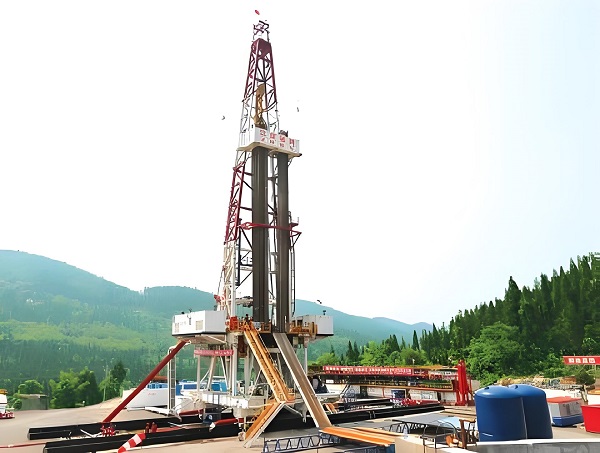
Most of SJ’s smart rigs operate at Level 2 (task automation) to Level 3 (conditional autonomy). However, the underlying AC‑VFD control architecture and data acquisition systems are designed to accommodate higher autonomy levels as technology matures.
2. AC‑VFD Electric Drive & Control Architecture
The foundation of a digital rig is the power and drive system. SJ offers three configurations: AC‑VFD, AC‑SCR‑DC and diesel‑mechanical. For digital automation, AC‑VFD is the recommended platform.
AC‑VFD System Overview
| Parameter | Specification |
|---|---|
| Power supply | AC 600 V – 690 V, 50 Hz or 60 Hz (grid or onboard AC generator sets) |
| Drive type | AC Variable Frequency Drive (VFD), IGBT‑based |
| Control architecture | PLC‑based centralised control with fieldbus communication (ProfiBus, Modbus, etc.) |
| Top drive (if fitted) | AC frequency conversion top drive, direct pipe rotation from derrick upper space |
| Drawworks control | VFD with regenerative braking and programmable speed/torque curves |
| Rotary table (if fitted) | Independent AC‑VFD drive, below‑drill‑floor mounting for larger working space |
| Mud pump control | Dedicated VFDs for each pump with flow and pressure control |
| Control interfaces | Touch‑screen HMI in driller’s cabin (centralised) plus portable remote panel |
| Data acquisition | 10 points/second high‑frequency sampling with hardware/software fault diagnostics |
| Automation level | Level 2 (task automation) to Level 3 (conditional autonomy) |
Key advantages of AC‑VFD over conventional DC (SCR) systems:
-
Better power efficiency: VFDs match motor speed to load, reducing energy waste
-
Lower maintenance: Fewer moving parts than mechanical transmissions or DC commutators
-
Regenerative braking: The system recovers energy during lowering operations
-
Inherent automation compatibility: Digital control interfaces are native to VFD technology
-
Rig instrumentation: One‑button operation for complete automated tasks
Digital Driller’s Control Cabin
The driller’s cabin is the command centre of the digital rig:
| Feature | Specification |
|---|---|
| Control mode | Centralised — all rig systems controlled from one location, plus spot‑control |
| HMI | Touch‑screen with real‑time drilling parameter display |
| Auto‑driller | PLC‑based automatic bit‑feed with programmable WOB and ROP |
| Monitoring | Real‑time display of hook load, rotary torque, pump pressure, pump rate, standpipe pressure, etc. |
| Data logging | Storage, printing and remote transmission of drilling parameters |
| Protection functions | Centralised long‑distance air control with multiple protection functions |
| Cabin rating | Positive‑pressure, air‑conditioned, explosion‑proof, dust‑tight |
The system performs real‑time monitoring of run‑in and pull‑out of hole and drilling conditions, and can be equipped with an optional digital controlled auto‑driller system. Drillers can optimise drilling parameters through the touch‑screen.
Master‑Slave Synchronous Motor Control — Torque Distribution
For rigs equipped with dual‑motor drawworks or multi‑motor mud pumps, SJ uses master‑slave control to ensure perfect load sharing between motors:
-
Master motor — operates in speed control mode (closed‑loop vector control), setting the reference speed for the system
-
Slave motor(s) — operate in torque control mode, following the master’s torque reference to ensure balanced load sharing, preventing one motor from overpowering the other and eliminating mechanical "nodding” and "shaking”
This is particularly important for deep‑well drilling where drawworks loads can exceed 4,000 kN.
3. Automated Pipe Handling System
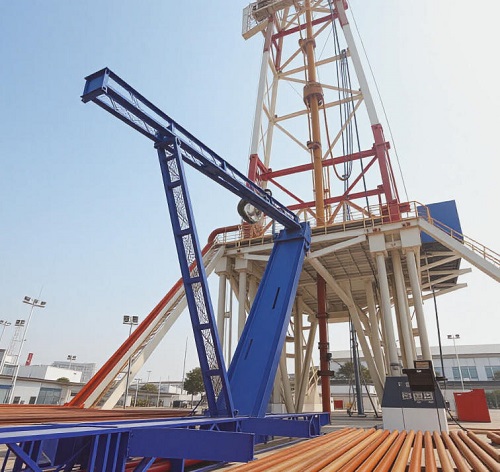
Manual pipe handling is the most dangerous and time‑consuming part of conventional drilling. SJ’s automated pipe handling system covers the entire workflow from pipe rack to well centre, reducing the drill floor crew from five to two operators and cutting connection time by up to 50 %.
Automatic Catwalk
| Parameter | Specification |
|---|---|
| Function | Transports tubulars (drill pipe, drill collars, casing, subs) from pipe rack to drill floor |
| Operation | Automatic lifting and lowering of drill string |
| Power source | Air winch (dual‑action) or hydraulic cylinders |
| Capacity | Multiple drill strings per cycle |
| Integration | Works with iron roughneck and pipe handler for fully automated connection cycles |
Iron Roughneck (ZMT120 Series)
| Parameter | Specification |
|---|---|
| Pipe range | 3½″ – 10″ (89 mm – 254 mm) |
| Max make‑up torque | 120,000 ft·lbs (162,000 N·m) |
| Max break‑out torque | 120,000 ft·lbs (162,000 N·m) |
| Spinner vertical stroke | 600 mm (23.6 in) |
| Control modes | Wireless remote / wired operation box / manual emergency |
| Hydraulic system pressure | 21 MPa (3,000 psi) |
| Clamp mechanism | 360° multi‑point radial contact with drill pipe |
| Connection time per pipe | ≤ 37 seconds (make/break cycle in automated sequence) |
A fully automated solution from SGPE completes the task in just 25 seconds per pipe on average.
Pipe Handler (Monkey Board Automation)
| Parameter | Specification |
|---|---|
| Function | Automatically transports, racks and stores drill strings from the well centre to the finger beams |
| Type options | Clamping type or supporting type |
| Stand handling | Three‑pipe stand capable |
| Integration | Works together with auto catwalk and iron roughneck for fully automated drilling operations |
The system handles all vertical pipe handling operations on the drill floor, including racking stands, building stands in the mousehole, picking up singles from the catwalk, laying out singles to the catwalk, and tripping in‑and‑out of the fingerboard.
4. Data Acquisition, Remote Monitoring & Intelligent Control
A digital rig is only as smart as its data. SJ incorporates a low‑cost automation (LCA) architecture with high‑frequency data collection and hardware/software fault diagnostic functions, fully adaptable to field safety and efficiency requirements.
SjpetroDAS Data Acquisition System
SJ has independently developed the SjpetroDAS Data Acquisition System, featuring:
| Feature | Specification |
|---|---|
| Data acquisition rate | 10 points per second high‑frequency sampling |
| Architecture | Low‑cost automation (LCA) and redundant architecture design |
| Fault diagnostics | Real‑time monitoring of VFD, motor, sensor and communication faults (hardware/software) |
| Remote transmission | Available for off‑site real‑time monitoring, data logging and performance optimisation |
| Reporting | Automatic generation of drilling reports and IADC daily drilling reports |
| Customisation | Support for customised function modules — load‑lifting limit auto‑control, injector head emergency stop (ESS), automatic tension/clamping alarms |
The data acquisition system is the "sensing core” of the rig, providing the foundation for digital twin technology and real‑time optimisation. It is the key perception unit that monitors the entire operational process and directly affects drilling efficiency and safety management.
-
Proven result: The ESS module has been applied in more than 100 wells in the Shengli Oilfield, establishing a solid safety defence line
-
Efficiency gain: The system helped achieve automatic coil tubing spooling, improving efficiency by more than 30 % compared to traditional manual spooling
Parameters Monitored
Typical parameters collected include:
-
Hook load, block position and speed
-
Rotary torque and rotary speed
-
Pump pressure, pump rate and mud temperature
-
Tank volume
-
BOP ram status
-
Wellbore pressure
-
Wind speed and ambient temperature
-
ROP (rate of penetration)
Digital Twin and AI Readiness
The system is compatible with digital twin technology that enables real‑time, accurate simulation of equipment action through remote intelligent monitoring. It uses real‑time data and advanced engineering capabilities to:
-
Make intelligent real‑time adjustments closer to technical limits
-
Optimise performance under constantly changing conditions, balancing safety and efficiency
The integration of downhole data with rig control systems is designed to optimise drilling efficiency and rate of penetration, while automation reduces non‑productive time and streamlines well delivery.
5. Integrated Moving Systems for Multi‑Well Pad Automation
On multi‑well pads, non‑productive time (NPT) between well slots is a major cost driver. SJ offers two integrated moving solutions that work with the rig’s automation platform.
Wheel‑Rail Walking System (Hydraulic Stepping Type)
| Parameter | Specification |
|---|---|
| Movement type | Hydraulic stepping — lift, push (600–1,000 mm/cycle), lower |
| Typical move time | 3–6 hours between wellheads |
| Operation | Single‑person from driller’s cabin |
| Best for | Dense cluster well pads with 5–10 m wellhead spacing |
Modular Fast‑Moving System (ZJ Series)
| Parameter | Specification |
|---|---|
| Design | Integrated modular structure for road transport without special permits |
| Rig‑up time | 2–4 days (depending on depth rating) |
| Crane required | No crane required for installation on BigEasy series (six‑trailer setup) |
| Best for | Multi‑pad campaigns requiring relocation between pads |
The rig can be equipped with a monolithic movement device to meet the moving requirement between wells by cluster drilling.
6. Digital Rig Product Types — SJ Configurations
SJ offers digital automated rigs in multiple configurations:
Type 1: Full AC‑VFD Electric Drive Smart Rig (Most Common)
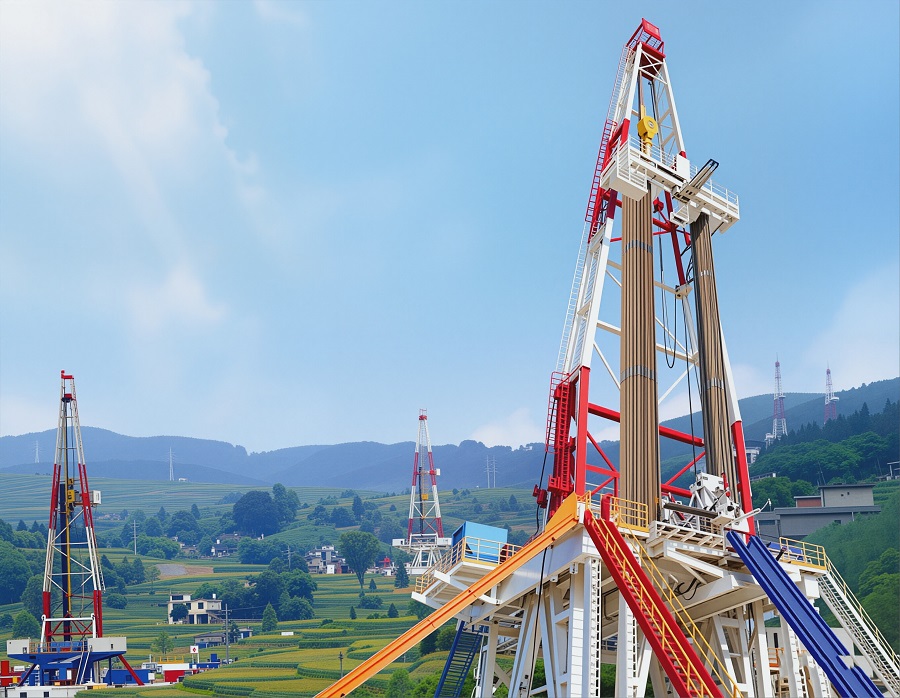
AC generator sets power VFD‑driven top drive, drawworks, mud pumps and automated pipe handling. Optimised for multi‑well pad drilling with integrated wheel‑rail moving.
-
Best for: Horizontal shale drilling, multi‑well pad development
-
Depth range: 3,000 m – 9,000 m (ZJ40 through ZJ90)
-
Crew reduction: 5 → 2 operators on drill floor
Type 2: BigEasy Trailer‑Mounted AC‑VFD Synchronous Smart Rig (Crane‑Free)
New conceptual AC VFD drilling rigs jointly developed with LOADMASTER. Entire rig installs using only six trailers — no crane required for installation.
-
Models: BE770 (ZJ50D) and BE550 (ZJ40D)
-
Best for: Remote operations, crane‑free setup
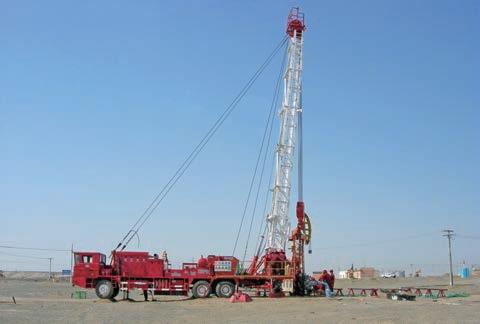
Type 3: ZJ Series AC‑VFD Synchronous Land Rig
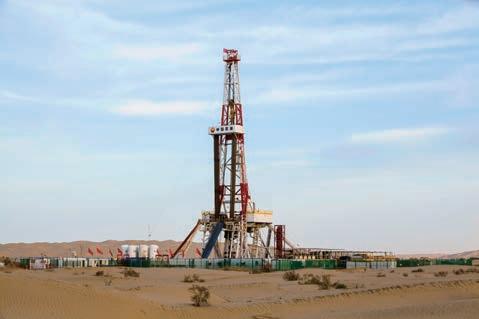
Full‑scale land drilling rigs with AC‑VFD electric drive and master‑slave motor control. PLC‑based control with VFD integration and regenerative braking.
-
Depth range: 3,000 m – 9,000 m (ZJ30 through ZJ90)
-
Motor configuration: Single, dual or quad‑motor drawworks
Type 4: Offshore Smart Automated Rig
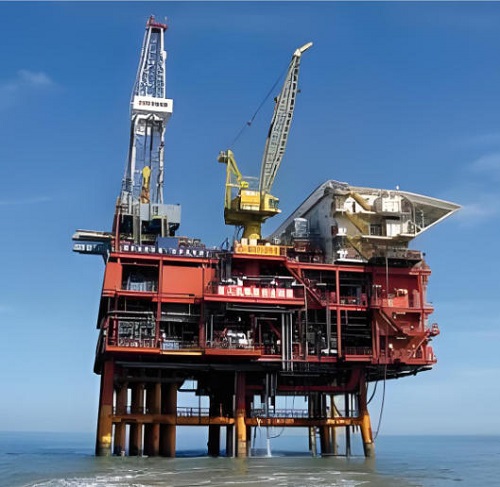
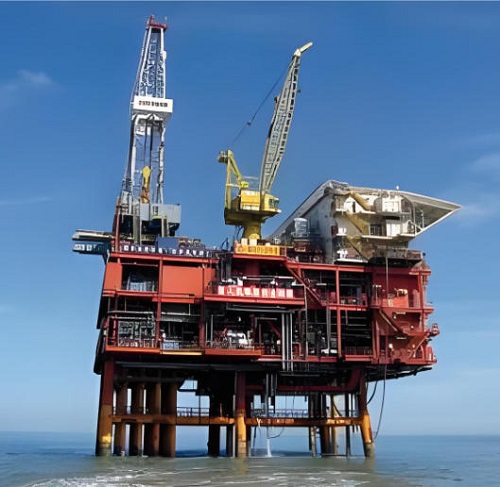
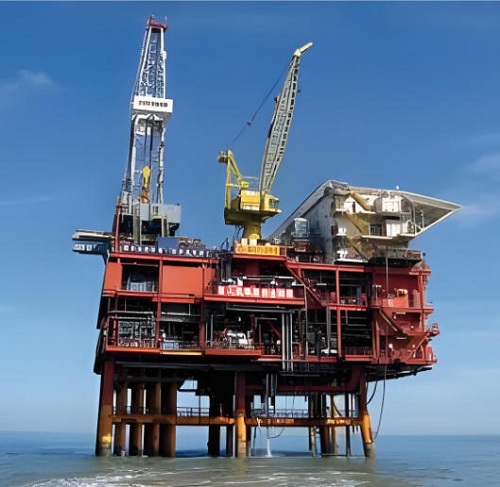
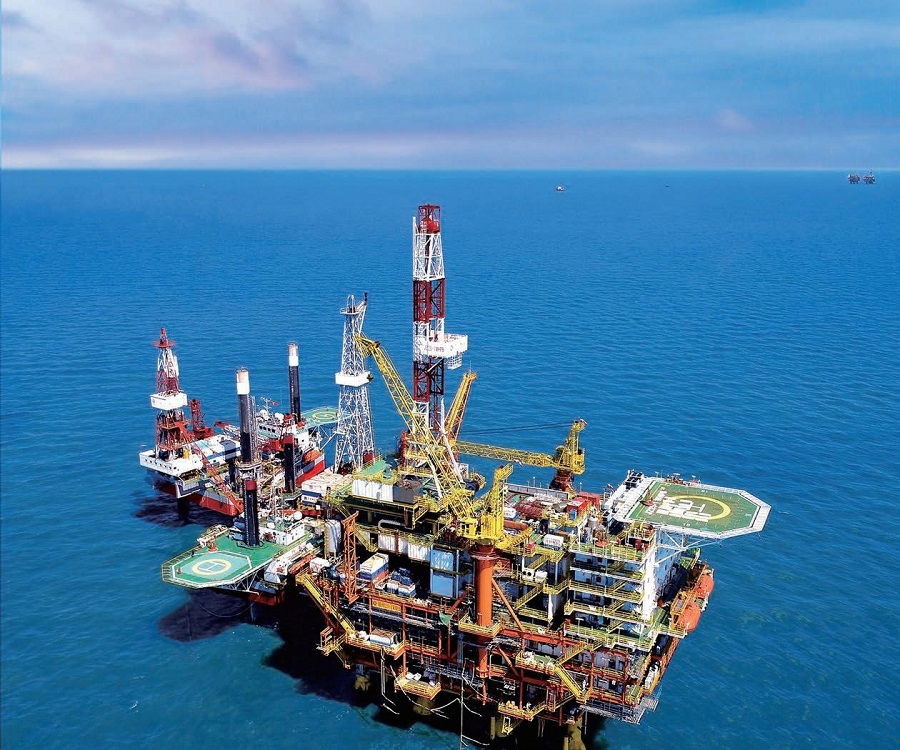
Explosion‑proof electrical systems (Exd II BT5/Exd II BT6 with IP55), corrosion‑resistant materials, high wind load capacity (>55 m/s), and space‑optimised modular design.
-
Certifications: API + ABS works approval + CE marking as required
Type 5: Automation Retrofit Package for Existing Rigs
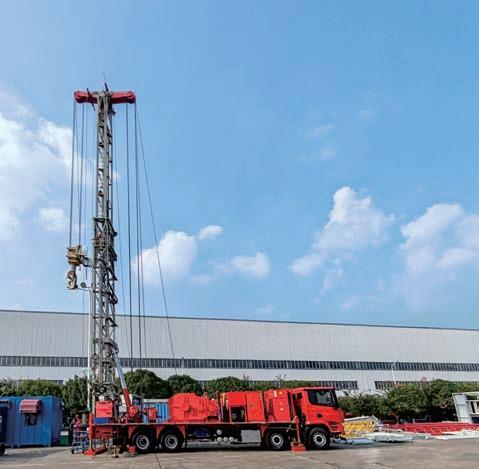
For operators extending the life of existing SJ drilling or workover rigs (ZJ or XJ series). Includes auto catwalk, iron roughneck, pipe handler, VFD control panels and data acquisition systems.
7. Technical Specifications — ZJ & XJ Series Digital Rigs
ZJ Series Land Drilling Rigs — Digital Configurations
SJ’s ZJ series AC‑VFD drilling rigs cover nominal drilling depths from 3,000 m to 9,000 m (4½″ drill pipe):
| Model | Nominal depth (4½″ DP, m) | Max hook load (kN) | Wireline dia. (mm) | Traveling block sheave OD (mm) | Rotary table opening (mm) | Drawworks power (kW/hp) |
|---|---|---|---|---|---|---|
| ZJ40/2250DB | 2,500–4,000 | 2,250 | 32 (1 1/4″) | 1,120 (44″) | 520.7 (20 1/2″) | 735 (1,000) |
| ZJ50/3150DB | 3,500–5,000 | 3,150 | 35 (1 3/8″) | 1,270 (50″) | 698.5 (27 1/2″) | 1,100 (1,500) |
| ZJ70/4500DB | 4,500–7,000 | 4,500 | 38 (1 1/2″) | 1,524 (60″) | 698.5 (27 1/2″) | 1,470 (2,000) |
| ZJ80/5850DB | 5,000–8,000 | 5,850 | 42 (1 5/8″) | 1,524 (60″) | 952.5 (37 1/2″) | 2,210 (3,000) |
| ZJ90/6750DB | 6,000–9,000 | 6,750 | 45 (1 3/4″) | 1,524 (60″) | 952.5 (37 1/2″) | 2,210 (3,000) |
| ZJ120/9000DB | 12,000 | 9,000 | 48 | 1,828 | 952.5 (37 1/2″) | 2,940 (4,000) |
-
All models feature stepless speed regulation for drawworks, rotary table and mud pumps
-
The rig is realised with an intelligent driller control system as well as data storage, printing and remote transmission by applying PLC automatic bit feed and real‑time monitoring of run‑in, pull‑out and drilling conditions
XJ Series Self‑Propelled Workover Rigs — Automation‑Ready
SJ has developed a series of workover rigs with maximum static load ranging from 300 kN to 2,250 kN and installed power from 235 HP to 1,300 HP:
| Model | Workover depth (2-7/8″ DP, m) | Nominal hook load (kN) | Max static load (kN) | Drawworks HP | Clearance height, mast (m) | Floor height (m) | Traveling system |
|---|---|---|---|---|---|---|---|
| XJ250 | 2,000 | 400 | 675 | 250 | 21.0 | 2.2 | 3×4 |
| XJ350 | 3,200 | 600 | 900 | 350 | 31.7 | 3.7 | 3×4 |
| XJ450 | 4,500 | 800 | 1,125 | 450 | 34.0 | 3.7 | 4×5 |
| XJ550 | 5,800 | 1,000 | 1,350 | 550 | 34.0 | 4.5 | 4×5 |
| XJ650 | 7,000 | 1,200 | 1,470 | 650 | 35.0 | 4.5 | 4×5 |
| XJ1000 | 8,000 | 1,500 | 1,800 | 750 | 38.0 | 6.0 | 5×6 |
| XJ1200 | 9,000 | 1,800 | 2,250 | 1,000 | 39.3 | 6.7 | 5×6 |
BigEasy Series — Trailer‑Mounted AC‑VFD Digital Rigs
Jointly developed with LOADMASTER:
| Parameter | BE550 (ZJ40D) | BE770 (ZJ50D) |
|---|---|---|
| Drilling depth (4½" DP) | 4,000 m | 5,000 m |
| Max hook load | 2,450 kN / 550,000 lb | 3,430 kN / 770,000 lb |
| Drive system | AC‑VFD electric | AC‑VFD electric |
| Installation | Six trailers, no crane required | Six trailers, no crane required |
| Mast type | Three‑section telescoping, hydraulic raise | Three‑section telescoping, hydraulic raise |
| Substructure | Parallelogram design, folding transport | Parallelogram design, folding transport |
8. Applications — Where Digital Rig Technology Delivers Maximum Value
| Application | Why Digital Rig Technology Matters | Recommended Configuration |
|---|---|---|
| Unconventional shale gas / tight oil | Long horizontal laterals demand precise steering, consistent WOB and fast cycles. Automation reduces connection time (≤ 37 s per pipe) and maintains optimal parameters | Type 1 — ZJ50 through ZJ90 with wheel‑rail moving |
| Multi‑well pad drilling | Same pad, multiple wells. Rig moves between slots without disassembly. Automated pipe handling maintains efficiency across multiple wells | Type 1 + integrated walking system |
| Remote basin drilling | Labour availability is limited. Automation reduces crew size and enables remote monitoring via data transmission | Type 2 (BigEasy) or Type 4 (fully autonomous‑ready) |
| Harsh environment drilling (arctic/desert) | Extreme conditions make manual operations dangerous and inefficient. Automation protects crews and maintains consistent performance | Type 3 with arctic/desert package |
| Offshore platform drilling | Space constraints, safety regulations and high operating costs make automation a necessity — not a luxury | Type 4 — offshore smart rig (explosion‑proof, corrosion‑resistant) |
| Deep and ultra‑deep well drilling | High pressures and complex formations require precision and consistency that AC‑VFD closed‑loop control delivers | Type 3 — ZJ70 or ZJ90 with full AC‑VFD |
| Operator training and crew development | Consistent automated operations provide a safer, more predictable environment for new crew members | Type 1 with enhanced training interfaces |
The global market for digital drilling rigs is growing rapidly, driven by safety regulations, labour constraints in remote operations, and the maturation of AI and robotics technologies. The Middle East remains the most buoyant drilling market, with significant growth in automated rig demand expected.
Field‑Proven Results
-
10 points/second data acquisition with real‑time fault diagnostics
-
ESS module applied in more than 100 wells in the Shengli Oilfield
-
30+ % efficiency gain in automatic coil tubing spooling
-
30 % reduction in assembly cycles for individual equipment through the intelligent manufacturing workshop
9. Why Choose SJ for Digital Rig Technology
1. Sinopec‑grade quality. As a wholly‑owned subsidiary of Sinopec Group, SJ operates under the quality management protocols that govern one of the world's largest integrated energy companies. The company has obtained more than 200 national patents and has reached internationally leading levels in fast‑moving drilling rigs, low‑temperature oil equipment and high‑power fracturing units.
2. Vertically integrated manufacturing. SJ produces everything — the AC‑VFD drives, the mast, substructure, drawworks, mud pumps, top drives, automated pipe handling equipment and high‑pressure fluid control products — under one roof. No assembling components from multiple vendors and hoping they integrate.
3. 50,000 m² assembly yard with full FAT. SJ possesses a rig assembly yard covering 50,000 m² with 24 rigging‑up positions and two offshore rig commissioning sites (four rig positions), where a test of 750 tons can be performed and 12 drilling or workover rigs can be assembled and commissioned simultaneously. Before any smart rig leaves the facility, it undergoes full factory acceptance testing (FAT).
4. Global after‑sales support. SJ maintains regional support infrastructure across the Middle East, Southeast Asia and other key markets, with 24/7 remote support, field service engineers for commissioning, operator training, preventive maintenance and emergency service.
5. API‑certified and third‑party verified. All digital rig components are API Q1, ISO 9001 and HSE management system certified, with API monograms for Spec 4F (structures), 7K (drilling equipment), 8C (hoisting equipment), 6A (wellhead equipment) and 16C (choke and kill manifolds). Third‑party inspection through DNV, ABS, Lloyd's or any accredited agency is available.
6. Future‑ready architecture. SJ’s digital rigs are designed with data acquisition capabilities compatible with AI and machine learning systems for predictive maintenance and optimisation. As the global market for autonomous drilling rigs grows, SJ's architecture is built to evolve.
7. Experienced engineering. The technical centre employs 314 engineers and is authorised to operate a post‑doctoral research station. SJ has mastered the design technologies for drilling rigs, workover rigs, cementing units and fracturing equipment, and can now provide a complete solution for customers at home and abroad.
8. Smart manufacturing workshop. SJ’s smart manufacturing workshop integrates automated production lines and digital management systems, achieving a 30 % reduction in assembly cycles for individual equipment.
10. Frequently Asked Questions (FAQ)
Q1: What is digital rig technology, and how does it differ from conventional drilling?
Digital rig technology integrates AC‑VFD electric drives, PLC‑based centralised control, automated pipe handling, digital driller’s HMIs and real‑time data acquisition with remote transmission. It operates at Level 2 (task automation) to Level 3 (conditional autonomy). Unlike conventional rigs where each function is operated manually and data is recorded manually on paper, a digital rig allows a single driller to control all systems through a touch‑screen HMI while receiving real‑time performance analytics remotely.
Q2: What is the difference between AC‑VFD and conventional SCR‑DC drive?
AC‑VFD (Variable Frequency Drive) uses AC motors with IGBT‑based inverters, offering higher efficiency, regenerative braking (energy recovery), fewer electrical connections, better motor efficiency, less noise and fewer emissions, and better compatibility with PLC‑based automation. AC‑SCR‑DC uses DC motors with AC generator sets and SCR rectifiers — simpler technology with proven reliability for medium‑depth drilling. SJ offers both depending on customer preference.
Q3: What automated pipe handling equipment does SJ provide?
SJ provides a complete ecosystem: Auto Catwalk — transports tubulars from the pipe rack area to the drill floor with automatic lifting and lowering. ZMT120 Iron Roughneck — makes up and breaks down pipe connections (3½″–10″, 120,000 ft·lbs torque, wireless remote control). Pipe handler — automatically transports, racks and stores drill strings from the well centre to the finger beams, working together with catwalk and roughneck for fully automated operations.
Q4: What is the data acquisition rate for SJ’s digital rigs?
SJ's SjpetroDAS data acquisition system collects data at 10 points per second with high‑frequency sampling, using a low‑cost automation (LCA) and redundant architecture design that includes hardware and software fault diagnostics.
Q5: Can SJ’s digital rigs be operated remotely?
Yes. SJ’s control architecture supports remote operations capability — allowing supervisory monitoring and control from off‑site locations. Data acquisition systems can be equipped with remote transmission modules, enabling real‑time visualisation of rig operations from any web‑enabled device.
Q6: What are the power supply options for AC‑VFD digital rigs?
SJ AC‑VFD rigs can operate from AC 600 V – 690 V, 50 Hz or 60 Hz power supplied by onboard AC generator sets (diesel‑driven), platform/pad grid power where available, or hybrid configurations.
Q7: What is the operating temperature rating for SJ digital rigs?
Standard rating: −30 °C to +55 °C for electrical components. Extended ratings available: Arctic package — −45 °C with low‑temperature steel, hydraulic fluids and heated enclosures. Desert package — +55 °C continuous operation with enhanced cooling, multi‑stage cyclonic air filtration and sand‑resistant coatings.
Q8: How many crew members are required to operate an SJ digital rig?
A full AC‑VFD smart rig with automated pipe handling reduces the drill floor crew from five to two operators. For fully autonomous‑ready configurations, the reduction can be up to 75 % on the drill floor.
Q9: What is the typical lead time for an SJ digital rig?
Lead times vary by depth rating, configuration and automation level: XJ series workover rigs — 6–9 months; ZJ series AC‑VFD smart rigs — 8–12 months; BigEasy series — 8–10 months; Offshore smart rigs — 10–14 months. Contact SJ’s sales team for current delivery schedules.
Q10: Does SJ provide training for digital rig systems?
Yes. SJ provides comprehensive training programs at its Jingzhou facility or on‑site at your location covering: AC‑VFD control system operation, touch‑screen HMI and PLC programming, auto‑catwalk and iron roughneck operation, data acquisition and remote monitoring systems, emergency procedures and failure recovery, and preventive maintenance for automated systems.