Workover technology
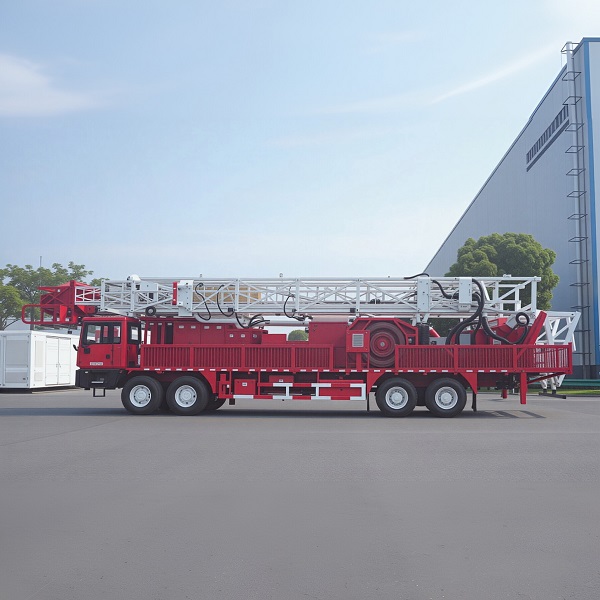
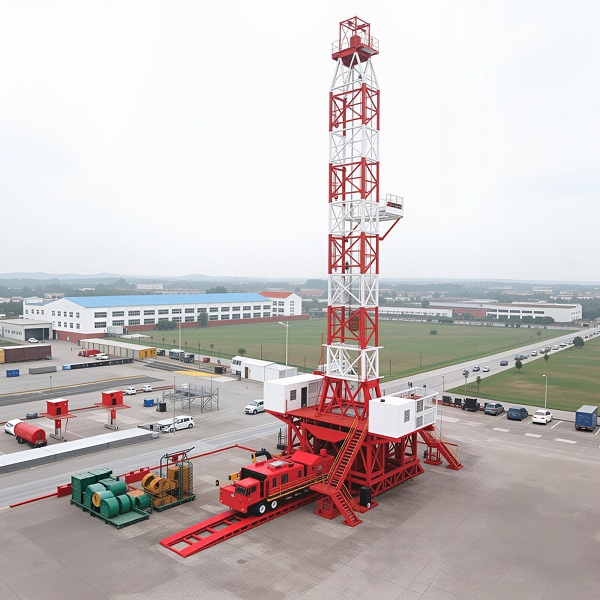
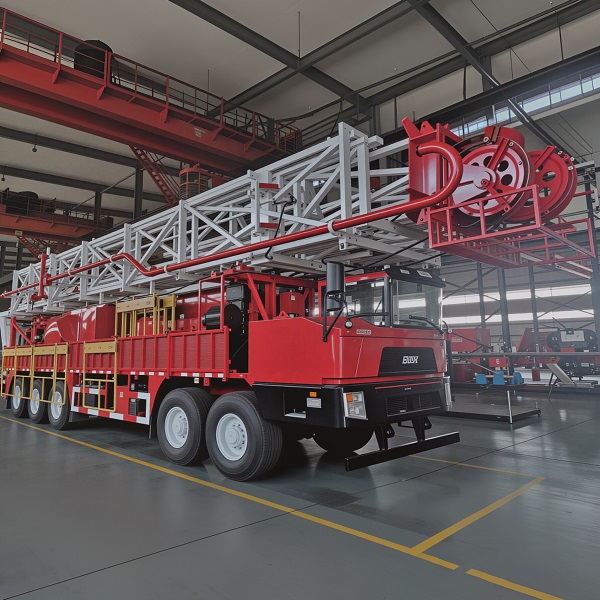
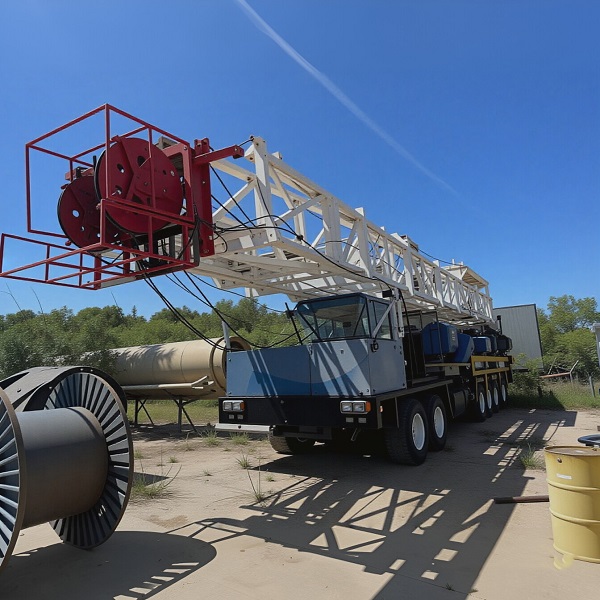
Technical Specifications – XJ Series Self‑Propelled Workover Rigs
The following table provides key technical specifications for SJ Petro XJ series workover rigs. Complete data sheets (dimensional drawings, API certifications, and test reports) are available upon request.
XJ Series – Workover Depth and Hook Load by Model
| Model | Workover Depth (2-7/8″ DP) | Nominal Hook Load | Max. Static Load | Drawworks HP | Drive Type | Carrier Drive |
|---|---|---|---|---|---|---|
| XJ150 | ~2,000m | 300 kN | 585 kN | 235 HP | 3×4 | 6×4 |
| XJ250 | 3,200m (10,500ft) | 400 kN | 675 kN | 250 HP | 3×4 | 10×8 |
| XJ350 | 3,200m | 600 kN | 900 kN | 350 HP | 3×4 | 10×8 |
| XJ450 | 4,500m | 800 kN | 1,125 kN | 450 HP | 4×5 | 10×8 |
| XJ550 | 5,800m | 1,000 kN | 1,350 kN | 550 HP | 4×5 | 10×8 |
| XJ650 | 7,000m | 1,200 kN | 1,470 kN | 650 HP | 4×5 | 12×8 |
| XJ1000 | 8,000m | 1,500 kN | 1,800 kN | 750 HP | 5×6 | 14×8 |
| XJ1200 | 9,000m | 1,800 kN | 2,250 kN | 1,000 HP | 5×6 | 14×10 |
XJ650 – Detailed Technical Parameters
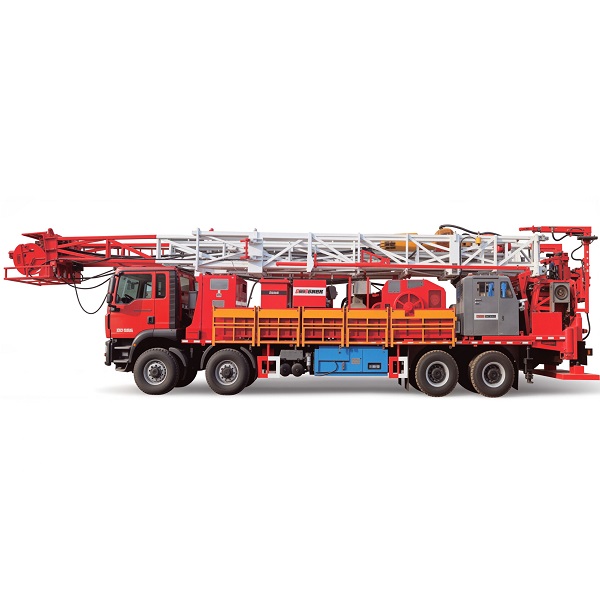
The XJ650 is our best‑selling heavy duty workover rig, renowned for powerful capability, stable performance, and great mobility among users in South America, Western Africa, and the Middle East.
| Parameter | Specification |
|---|---|
| Workover Depth (2-7/8″ DP) | 7,000 m (23,000 ft) |
| Servicing Depth (2-7/8″ EUE tubing) | 8,500 m (27,900 ft) |
| Drilling Depth (3-1/2″ DP) | 2,000 m (6,560 ft) |
| Max. Static Hook Load | 1,580 kN (355,200 lbf) |
| Max. Hook Load | 1,575 kN (354,000 lbf) |
| Engine Power | Caterpillar C18, 470 kW (630 HP) at 2,100 rpm |
| Racking Board Capacity | 2,000 m of 4-1/2″ DP |
| Mast Height | 35 m (115 ft) |
| Wireline Diameter | Φ29 mm (1-1/8″) |
| Traveling System | 4×5 |
| Overall Dimensions (L×W×H) | 19.9 × 3.1 × 4.37 m (65.3 × 10.2 × 14.3 ft) |
| Total Weight | 55,000 kg (121,250 lb) |
| Max. Travel Speed | 45 km/h (28 mph) |
| Carrier Type | Self‑propelled 12×8 |
| Air Assist Brake System | KOBELT Disc with matched caliper |
XJ250 – Detailed Technical Parameters
The XJ250 is widely rated by customers worldwide as the best economic workover rig for its reliable performance, innovative design, and economical cost.
| Parameter | Specification |
|---|---|
| Workover Depth (2-7/8″ DP) | 3,200 m (10,500 ft) |
| Servicing Depth (2-7/8″ EUE tubing) | 3,200 m (10,500 ft) |
| Rated Hook Load | 400 kN (90,000 lbf) |
| Max. Hook Load | 735 kN (165,000 lbf) |
| Engine | Caterpillar C9, 260 kW (350 HP) at 2,100 rpm |
| Transmission | Allison 4700 OFS |
| Derrick Height | 31 m (102 ft) |
| Racking Board Capacity | 3,200 m of 2-7/8″ EUE tubing |
| Max. Travel Speed | 60 km/h (limited to 45 km/h) |
| Carrier | Self‑propelled 10×8 |
| Overall Dimensions (L×W×H) | 18.5 × 2.9 × 4.2 m |
| Weight | 50,000 kg (110,230 lb) |
Applications – Where XJ Series Workover Technology Excels
The XJ series is deployed globally across a wide range of well intervention and servicing operations:
-
Workover and recompletion – pulling rods, tubing, and pumps; fishing; scale removal; zone isolation – covering well depths from 1,000m to 9,000m
-
Shallow to medium drilling – when equipped with a rotary table, the rig can handle drilling operations for medium and shallow wells
-
Cluster well development – self‑propelled 10×8 or 12×8 carriers allow rapid moves between closely spaced wellheads, eliminating crane and lowboy logistics
-
Remote exploration – all power systems are mounted on a single carrier, making installation and movement fast and efficient
-
Heavy workover in deep wells – XJ650, XJ1000, and XJ1200 handle depths up to 9,000m with maximum static loads up to 2,250 kN
-
Arctic campaigns – heated cabins and low‑temperature hydraulics are available; SJ Petro has delivered rigs to Russia’s Orenburg field at -45°C
-
Desert development – sand‑sealed components and reinforced chassis for Middle Eastern operations
Product Types – XJ Series Configurations
We manufacture the full XJ series of self‑propelled workover rigs, covering light, medium, heavy, and ultra‑deep capacity.
1. XJ150–XJ250 – Light to Medium Workover (Entry Level)
Best for shallow wells, light servicing, water wells, and small operators. The XJ250 is rated as the best economic workover rig for its reliable performance and economical cost [8†L10-L12]. Drivetrain: 6×6 carrier with Caterpillar C9 engine and Allison transmission.
2. XJ350–XJ550 – Medium to Heavy Workover (Standard Workhorse)
Best for most onshore workover operations – conventional oil, mature fields, shallow drilling. The XJ550 reaches 5,800m workover depth (2-7/8″ DP) with 4,500m capability for 3-1/2″ DP [10†L18-L19]. Traveling system: 4×5.
3. XJ650–XJ1200 – Heavy to Ultra‑Deep Workover
Best for deep wells, HPHT intervention, and dual‑purpose drilling/workover needs. The XJ650 serves as a 2‑in‑1 rig performing both workover (7,000m) and drilling (2,000m) operations [9†L5-L6]. The XJ1200 reaches 9,000m workover depth with a massive 2,250 kN static load [10†L20-L22] and 14×10 self‑propelled chassis.
4. Custom & Specialized Workover Rigs
We build workover rigs for extreme environments:
-
Arctic package -45°C – heated cabins, low‑temperature hydraulic fluids, engine block heaters (proven in Russia)
-
Desert package 50°C+ – oversized cooling, sand‑sealed enclosures, reinforced chassis
-
Offshore skid‑mounted variant – corrosion‑protected, ABS/DNV certification available
Why Choose SJ Petro for Workover Technology?
Because a workover rig is not just a machine – it is a long‑term investment in production optimization. You need a manufacturer who builds, certifies, and supports the entire system.
| Your Workover Challenge | SJ Petro’s Answer |
|---|---|
| "I need a rig that can move between wells weekly without a crane.” | Self‑propelled 6×6 to 14×10 carriers – drive to location, raise mast hydraulically, no crane needed. |
| "I want a rig that can do both workover and drilling.” | XJ650 and larger models are true 2‑in‑1 machines – workover at 7,000m and drilling at 2,000m. |
| "I need API certification for my international tender.” | Full API 4F, 7K, 8C certification. API monogram available on request. |
| "We want to transition from reactive repairs to predictive maintenance.” | SOFElink provides real‑time monitoring, fault alarms, intelligent analysis, and key component diagnosis – helping you anticipate failures before they happen. |
| "My crew is small. Operation needs to be simple and safe.” | Fully integrated controls with hydraulic mast raising. Safety systems include multiple brakes and anti‑torque release. |
| "I operate in extreme environments – Siberia or the Middle East.” | Arctic and desert packages available. Proven track record in Russia’s -45°C Orenburg field. |
More reasons to trust SJ Petro:
-
Over 40 years of workover rig manufacturing – not a new entrant
-
In‑house manufacturing – chassis integration, mast fabrication, and control systems all under one roof
-
API 4F, 7K, 8C certified – full API compliance
-
Global track record – XJ series rigs operating in South America, Western Africa, Middle East, Russia, and Southeast Asia
-
24‑hour spare parts shipping – emergency parts from main warehouse
-
Lease and financing options – milestone payments, operating leases, and direct financing available
Frequently Asked Questions (FAQ) – Workover Technology
Q1: What is the difference between a workover rig and a drilling rig?
A: A workover rig is designed for well servicing operations – pulling tubing and rods, fishing, pump replacement, zone isolation – typically on existing wells that are already producing. A drilling rig is designed to drill new wells from surface. The XJ series bridges this gap: many models (XJ550 and above) are true 2‑in‑1 machines capable of both workover and shallow to medium drilling when equipped with a rotary table.
Q2: What workover depths can your XJ series rigs reach?
A: The XJ series covers the full spectrum:
| Model | Workover Depth (2-7/8″ DP) |
|---|---|
| XJ250 | 3,200 m (10,500 ft) |
| XJ350 | 3,200 m |
| XJ450 | 4,500 m |
| XJ550 | 5,800 m |
| XJ650 | 7,000 m (23,000 ft) |
| XJ1000 | 8,000 m |
| XJ1200 | 9,000 m |
Complete depth capabilities are available in the technical specifications table above.
Q3: Are your workover rigs API certified?
A: Yes. Our XJ series is designed and manufactured in accordance with API Spec Q1, 4F, 7K, 8C and relevant industry standards. API monogram is available upon request.
Q4: What is the lead time for an XJ series workover rig?
A: Standard lead times from order confirmation:
-
XJ250–XJ350 (standard configuration): 4–5 months
-
XJ450–XJ550 (standard configuration): 5–6 months
-
XJ650–XJ1200 (standard configuration): 6–8 months
-
Custom builds (arctic, desert, special requirements): 8–10 months
Expedited delivery may be available – contact our sales team.
Q5: Can I get a refurbished workover rig to save costs?
A: Yes. We occasionally have trade‑ins from customers upgrading their fleets. Refurbished rigs are completely disassembled, inspected, fitted with new wear parts, repainted, load tested, and come with a 6‑month warranty. Price is typically 40–60% of new.
Q6: What is the warranty on an XJ series workover rig?
A: 12 months after commissioning or 18 months after shipment – whichever occurs first. The warranty covers manufacturing defects on all components. Wear parts are not covered but are available as spares. Extended warranty (up to 5 years) is available.
Q7: What training do you provide for workover rig operators?
A: For every rig purchase, we include 1–2 weeks of on‑site training during commissioning, covering rig operation, maintenance, safety protocols, and SOFElink digital platform. Digital manuals, video tutorials, and remote support are also provided.
Q8: Do you offer financing or leasing for workover rigs?
A: Yes. For qualified buyers, we offer direct financing (through partner banks, terms up to 5 years), operating leases (low monthly payments), and milestone payment plans (30/40/30).
Q9: How does the SOFElink digital platform benefit my workover operations?
A: SOFElink provides 12 core functions including real‑time equipment tracking, fuel consumption monitoring, fault alarms, predictive maintenance planning, intelligent analysis of operating conditions, and key component health diagnostics [16†L5][17†L3-L8]. This allows you to transition from reactive repairs to proactive, planned interventions – reducing unplanned downtime and extending equipment life .