
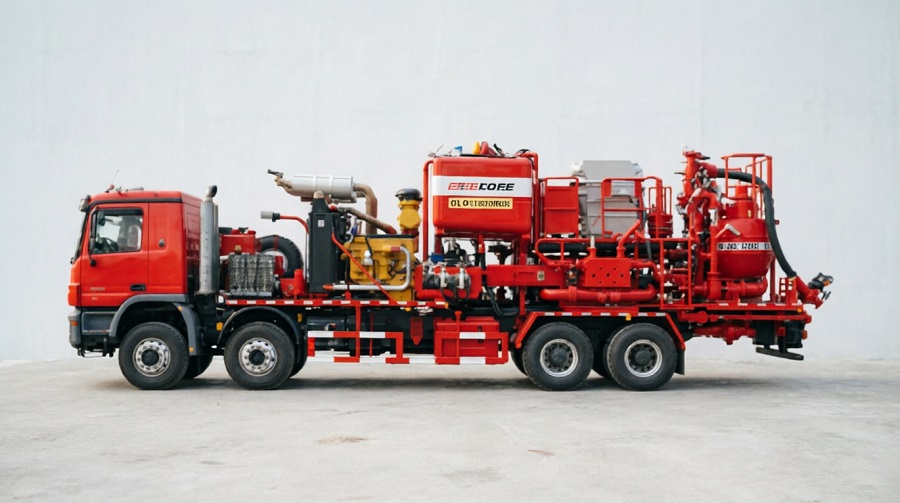
Hydraulic fracturing truck
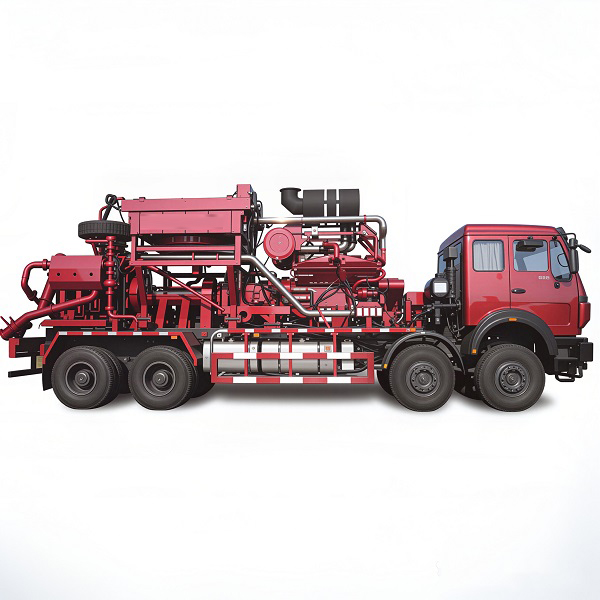
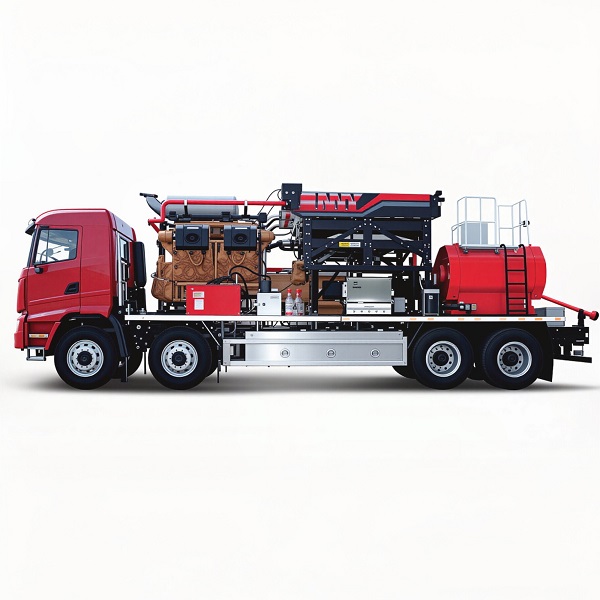
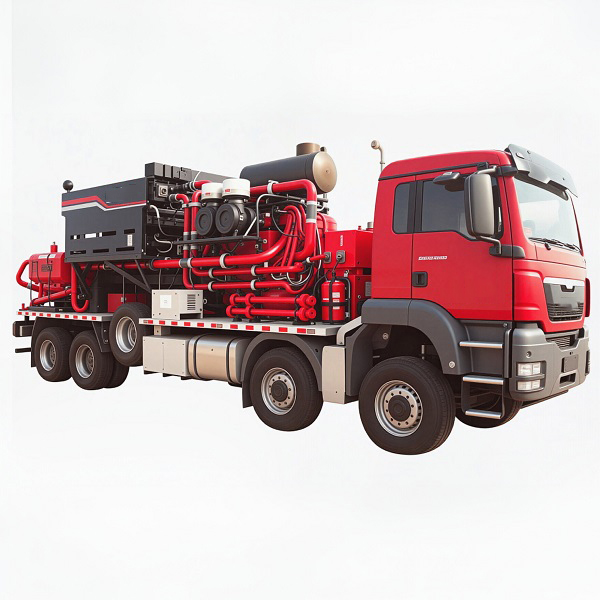
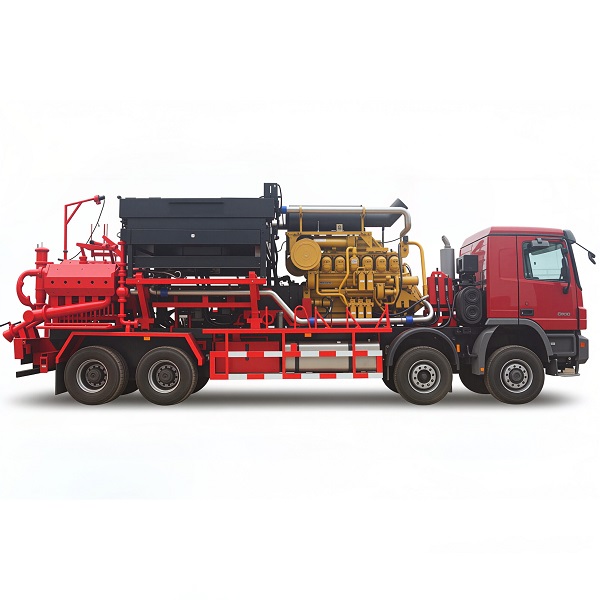
Technical Specifications – PGT‑2500 Hydraulic Fracturing Truck
| Parameter | Specification |
|---|---|
| Model | PGT‑2500 (PGT‑2500A / PGT‑2500B) |
| Pump Model | QPA2500 quintuplex plunger pump |
| Max Horsepower | 2,500 HHP (1,864 kW) |
| Max Discharge Pressure | 105 MPa / 15,312 PSI |
| Max Flow Rate | 4.65 m³/min (with 5‑1/2″ plungers) |
| Number of Plungers | 5 |
| Plunger Diameters | 4″, 4‑1/2″, 5″, 5‑1/2″ |
| Stroke Length | 8″ (203 mm) |
| Engine (for hydraulic pump power) | Caterpillar 3512C / MTU 12V4000, 2,500 BHP |
| Transmission | Allison 9826 OFS / CAT TH55 |
| Chassis | Mercedes‑Benz 4144 8×6 or equivalent |
| Overall Dimensions (L×W×H) | 12,000 × 2,500 × 4,100 mm (approx.) |
| Weight (GVW) | Approx. 38 metric tons |
| Integrated Blender Sand Rate | Optional – up to 2,500 lbs/min (1,134 kg/min) |
| Chemical Injection Points | 3 (optional 4) |
| Control System | SOFElink with local & remote capability |
| Data Recording | Pressure, rate, sand conc., chemical rates (all stages) |
| Working Temperature | –20°C to +50°C (Arctic package available: –45°C) |
| API Compliance | API 7K (pump), API 6A (valves & iron) |
| Noise Level at 10m | ~105 dBA (standard), <90 dBA with optional enclosure |
Applications – Where the Hydraulic Fracturing Truck Excels
The truck is not designed to replace a 40,000 HP electric spread on a large shale pad. But for hundreds of other operations, it’s the perfect solution.
-
Emergency well stimulation – well starts sanding up or losing production? Roll the truck and have it pumping within hours.
-
Remote exploration wells – no pad infrastructure, no crane, no multiple trailers. One truck does it all.
-
Workover fracturing – small to medium jobs (20,000 – 200,000 lbs proppant) – the truck is sized perfectly.
-
Acidizing treatments – matrix acidizing in conventional wells. The truck’s chemical injection system handles aggressive acids with proper material upgrades.
-
Coal bed methane (CBM) stimulation – low pressure, moderate sand volumes – the truck is very cost‑effective.
-
Well testing and flowback assistance – use the pump to assist flowback or inject tracers.
-
Offshore platform supply – the truck is too large for most platforms, but the same pump in skid form is used offshore. The truck version is for onshore rapid response.
-
Fracturing of single vertical wells – when a full spread is overkill, one truck does the job.
Product Types – Choosing Your Configuration
We offer the hydraulic fracturing truck in several variants, depending on how much integration you need.
1. PGT‑2500 – Pump + Control Only (No Blender)
Best for: Operators who already have a separate blender or only need pumping (e.g., acidizing, water injection, well testing).
What’s included:
-
QPA2500 pump with engine & transmission
-
SOFElink control system
-
Suction and discharge manifolds on truck
-
Chemical injection (optional)
You connect the truck’s suction to your fluid source (frac tanks, water truck) and discharge to the wellhead. No blending on board.
2. PGT‑2500B – Pump + Integrated Blender (All‑in‑One)
Best for: Proppant fracturing where you want a single truck to handle pumping and blending.
What’s included:
-
All PGT‑2500 features, plus:
-
Small closed‑loop blender (sand rate up to 2,500 lbs/min)
-
Proppant hopper (2,000‑3,000 lb capacity – enough for multiple stages if you refill between stages)
-
Mass flow sensors and automated auger control
-
Chemical injection integrated with blender
Note: The onboard hopper holds limited sand – for large jobs, you’ll need a sand delivery system (pneumatic trailer) to refill between stages. For jobs under 50,000 lbs total sand, the onboard hopper is sufficient.
3. PGT‑2500Arctic – Cold‑Weather Version
Best for: Operations in Siberia, Canada, Alaska, or any region with sustained temperatures below –20°C.
Features:
-
Heated fluid end (electric heat tracing)
-
Low‑temperature hydraulic fluids (–55°C pour point)
-
Engine block heater and battery warmers
-
Insulated and heated control cab
-
Arctic‑grade seals and elastomers
4. PGT‑2500E – Electric Drive Version (Grid‑Connected)
Best for: Operations with access to grid power, where zero on‑site emissions and lower noise are required.
-
Replaces diesel engine with electric motor (1,800 kW / 2,500 HP)
-
Requires 6–10 kV power connection or mobile substation
-
Zero emissions, quieter (≈85 dBA)
-
Lower operating cost per hour
Why Choose SJ Petro for Your Hydraulic Fracturing Truck?
Because you need a machine that starts when you turn the key, pumps when you need it, and keeps running job after job.
| Your Challenge | SJ Petro’s Answer |
|---|---|
| "We have multiple remote wells that need stimulation. Moving a full spread is too expensive.” | One truck, one driver, one crew. Mobilize for a fraction of the cost of a full spread. |
| "Our wells are in hilly terrain. A tractor‑trailer can’t make the turn.” | 8×6 chassis with short wheelbase and tight turning radius – designed for tough access. |
| "We need to pump sand, but we don’t have a separate blender.” | Choose the PGT‑2500B with integrated blender. One truck, no extra equipment. |
| "Our crew is small – we can’t run a 10‑person spread.” | The truck requires 2–3 people to operate (one driver/operator, one to connect iron, one to monitor fluid supply). |
| "We worry about maintenance on a truck‑mounted unit.” | The pump and engine are the same as our skid units – fully serviceable. We provide complete parts and field support. |
More reasons operators choose our fracturing truck:
-
Sinopec Group engineering – we built the world’s first truck‑mounted 2,500 HP frac unit in 2008
-
Proven reliability – PGT‑2500 trucks have logged tens of thousands of pumping hours in China, Russia, and the Middle East
-
API certified – pump meets API 7K, manifold meets API 6A
-
One‑stop solution – the truck replaces pump, blender, chemical unit, and control van
-
Fast parts support – we stock pump fluid end components, transmission parts, and chassis spares globally
-
Training included – we train your operator and maintenance crew during delivery
Frequently Asked Questions (FAQ)
Q1: What is the maximum sand volume the PGT‑2500B truck can pump without refilling?
A: The onboard hopper holds approximately 2,500–3,000 lbs (1,100–1,360 kg) of proppant. At a typical sand concentration of 5 pounds per gallon (0.6 kg/L), that’s enough for about 500 gallons (1,900 liters) of slurry – roughly 10–15 minutes of pumping at 35 bpm. For larger jobs, you can refill the hopper between stages using a pneumatic sand trailer or a front‑end loader. Many operators stage a sand trailer next to the truck and refill during pump‑down or wireline operations.
Q2: Can the truck pump crosslinked gel or only slickwater?
A: Yes. The integrated blender can handle linear gel, crosslinked gel, slickwater, and acid. The chemical injection system adds gel concentrate, crosslinker, breaker, and surfactant at programmable rates. For high‑viscosity fluids, ensure your fluid supply (frac tanks) is properly hydrated before reaching the truck’s suction.
Q3: How long does it take to set up the truck on a new location?
A: Assuming the wellhead is prepared (hammer union wing ready) and frac tanks are spotted within hose length:
-
Drive onto pad, level truck: 30 minutes
-
Connect suction hoses (to tanks): 30–45 minutes
-
Connect discharge iron (to wellhead): 30–45 minutes
-
Connect electric or check diesel: 15 minutes
-
System pressure test: 30 minutes
-
Total: 2.5 – 3.5 hours with a crew of 3.
For the PGT‑2500B with integrated blender, there’s no separate blender to rig up – you’re done when the truck is connected.
Q4: What is the fuel consumption of the diesel engine?
A: At full load (2,500 HP), the Caterpillar or MTU engine consumes approximately 180–220 liters (48–58 gallons) of diesel per hour. At partial load (e.g., 1,500 HP), consumption drops to about 120–150 L/hr. For a typical 4‑hour pumping job, budget ~800 liters (210 gallons) of diesel. The electric drive version uses grid power – cost depends on local electricity rates.
Q5: Can I use the truck for both high‑pressure fracturing and low‑pressure injection (e.g., water disposal)?
A: Yes – but you’ll need to adjust the pump configuration. The QPA2500 can be operated at lower pressures and rates. However, for routine low‑pressure water injection, the truck’s fuel consumption is excessive. We recommend using a dedicated, smaller injection pump for that service. But for occasional use, the truck works fine.
Q6: What is the warranty on the hydraulic fracturing truck?
A: 12 months after commissioning or 18 months after shipment (whichever comes first). The warranty covers:
-
Pump fluid end (manufacturing defects)
-
Power end components (bearings, crankshaft)
-
Engine and transmission (per OEM terms)
-
Chassis and hydraulic systems
-
SOFElink electronics
Wear parts (valves, seats, packing, plungers) are not covered but are available as spares.
Q7: Do you provide operator training?
A: Yes. For every truck purchase, we include:
-
5 days of on‑site training (classroom + hands‑on) for up to 4 students
-
Digital operation and maintenance manuals
-
3 months of remote video support
-
Access to our online training portal (videos, checklists, troubleshooting guides)
Additional training (more days, factory course) is available at extra cost.
Q8: Can I mount the same pump on a different chassis (e.g., a used truck I already own)?
A: Yes. We offer the QPA2500 pump as a standalone unit with its own engine and transmission package, ready to be mounted on your chassis. However, we strongly recommend using our engineered chassis – the weight distribution, PTO drives, and cooling systems are matched to the pump’s requirements. Retrofitting onto an unknown truck can lead to cooling problems, transmission failures, and safety issues. We provide full engineering drawings for third‑party mounting, but we do not assume liability for improper installation.
Q9: What spare parts should I keep on hand for the truck?
A: For a single truck operating 500–1,000 pumping hours per year, we recommend:
-
2 sets of valves & seats (tungsten carbide)
-
4 sets of packing (all 5 plungers)
-
2 plungers in your operating size
-
1 set of quick‑change valve cover seals
-
1 set of suction/discharge valve springs
-
Assorted gaskets and O‑rings for fluid end
-
2 engine oil filters + 2 fuel filters
-
2 transmission filters + oil
-
Spare hammer union seals (2″ and 3″ sizes)
We can provide a custom spare parts list based on your expected hours and fluid type.
Q10: How does the price of a hydraulic fracturing truck compare to buying a skid‑mounted pump plus a separate blender and truck?
A: A complete PGT‑2500B truck (pump + blender + control + chassis) typically costs 15–30% less than buying a separate skid pump, a blender, a crane to load them, and a truck to tow them – plus the integration time. For operators who move frequently, the all‑in‑one truck is almost always the lower total‑cost‑of‑ownership option.
Q11: Can the truck be used for coiled tubing fracturing (small volumes, low rates)?
A: Yes. Many coiled tubing fracturing jobs require only 0.5–2.0 bpm at moderate pressures. The QPA2500 can be throttled down to very low rates. The integrated blender can also handle the small sand volumes typical of CT fracturing. The truck is an excellent match for CT‑conveyed stimulation.
Q12: Do you offer a lease or rental option for the hydraulic fracturing truck?
A: Yes. For operators who need a truck for a specific project or a trial period, we offer short‑term and long‑term leases through our finance partners. Typical terms: 3–12 months with option to purchase at end. Contact our sales team for a rental quote.







