
Fracturing system
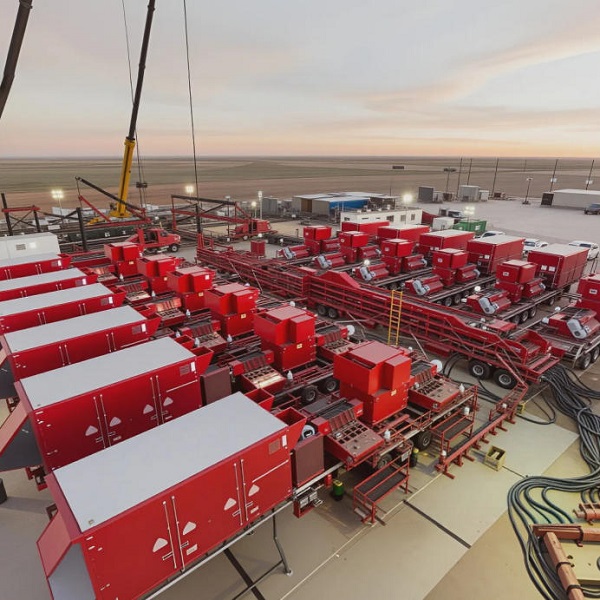
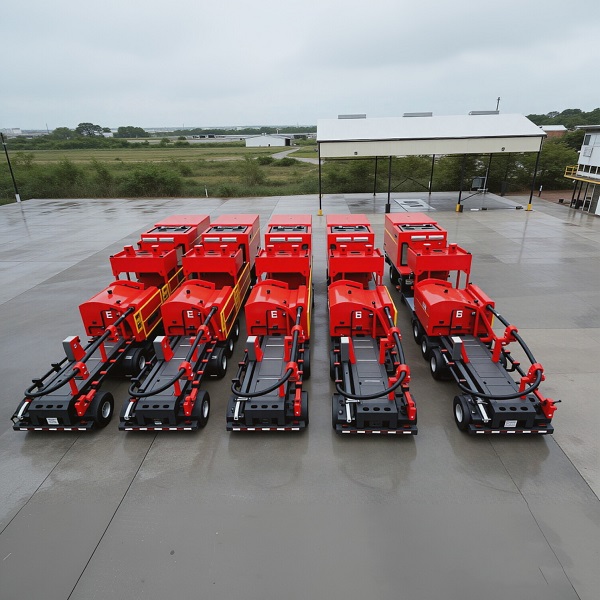
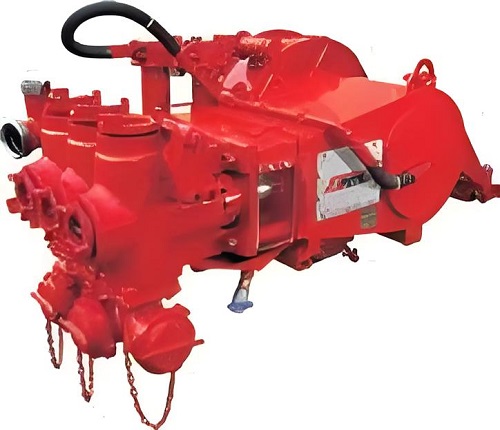
Technical Specifications – Complete Fracturing System
The tables below provide key specifications for a typical 40,000 HP all‑electric fracturing system. Systems can be scaled up or down, and diesel or hybrid configurations are available.
Typical 40,000 HP All‑Electric Fracturing System
| Component | Quantity | Key Specifications |
|---|---|---|
| SCF8000 electric frac skid | 5 units | 8,000 HP continuous each; 175 MPa; 10″ stroke, 7‑cylinder |
| Electric blender | 2 units | 6,000 lbs/min sand rate; ±2% accuracy; closed‑loop proppant control |
| SOFElink data van | 1 unit | Full spread control; predictive maintenance; automated stage execution |
| Mobile substation + VFD | 1 set | 6‑35 kV input; 30‑40 MW capacity; transformer + switchgear + VFD cabinets |
| SGH175 high‑pressure manifold | 1 set | 175 MPa; 4″ and 5″ lines; API 6A; includes gate valves, swivels, flow crosses |
| Chemical additive system | 1 set | 8 injection points; integrated with SOFElink |
| Suction manifold & transfer pumps | 1 set | Low‑pressure (200 PSI) for connecting frac tanks |
| Flow iron & hammer unions | 1 set | 3″ and 4″; 175 MPa rated; tungsten carbide erosion protection |
| Spare parts kit | 1 set | Valves, seats, packing, plungers, seals – 500+ hours of operation |
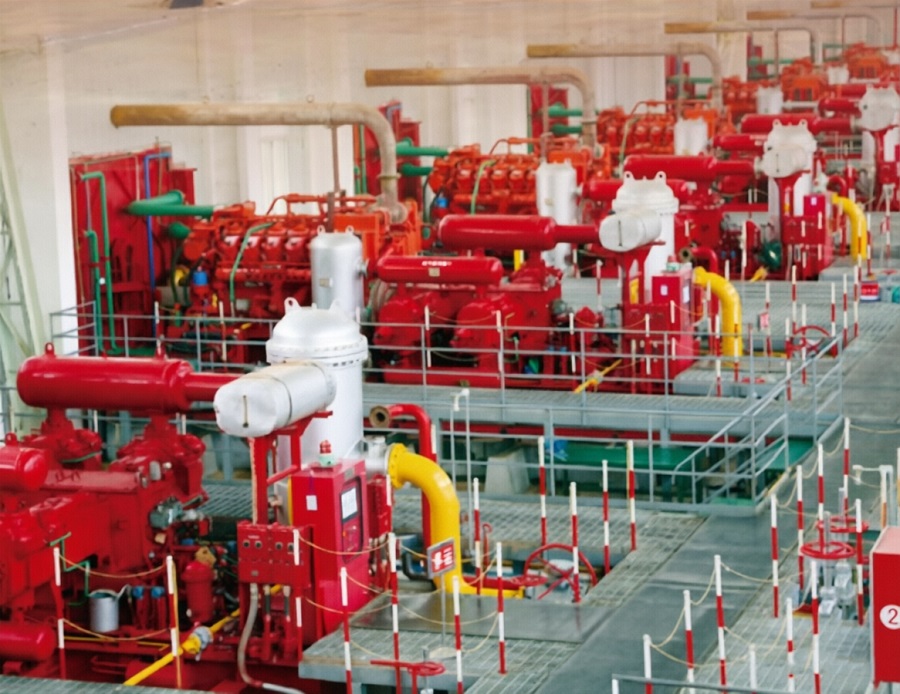
System Performance Parameters
| Parameter | Specification |
|---|---|
| Total continuous horsepower | 40,000 HP (29,800 kW) |
| Maximum treating pressure | 175 MPa (25,400 PSI) |
| Maximum flow rate (approximate) | 12–15 bpm @ 140 MPa; higher flow at lower pressure |
| Maximum sand rate | 12,000 lbs/min (combined from 2 blenders) |
| Number of simultaneous wellhead connections | Up to 4 (zipper frac configuration) |
| Footprint (typical pad) | 50m × 40m (depending on well spacing) |
| Rig‑up time (first pad) | 3–5 days (includes all connections and testing) |
| Rig‑up time (subsequent pads, same system) | 1–2 days (system moves as assembled units) |
| Emissions (electric configuration) | Zero on‑site |
| Noise level at 10m | ~85 dBA (22% lower than equivalent diesel spread) |
| API Compliance | Pumps: API 7K; Manifold: API 6A; Full documentation |
Product Types – Fracturing System Configurations
We offer fracturing systems in three standard capacity tiers, each available in diesel, electric, or hybrid.
1. Standard Diesel System (20,000 – 30,000 HP)
Best for: Conventional fracturing, tight gas, remote locations without grid, operators new to hydraulic fracturing.
Typical configuration:
-
8–12 × QPA2500 diesel skids (2,500 HP each)
-
2 × diesel blenders (6,000 lbs/min)
-
1 × SOFElink data van (Basic)
-
105 MPa or 140 MPa manifold
-
Chemical additive system (4–6 points)
-
Full iron package
-
Spare parts kit
Lead time: 5–6 months
2. All‑Electric System (30,000 – 60,000 HP)
Best for: Deep shale gas, HPHT wells, low‑emission projects, continuous‑duty campaigns.
Typical configuration:
-
4–8 × SCF8000 electric skids (8,000 HP each)
-
2 × electric blenders (6,000 lbs/min)
-
1 × SOFElink Advanced data van with predictive maintenance
-
1 × mobile substation + VFD (if grid not available)
-
SGH175 manifold (175 MPa)
-
8‑point chemical additive system
-
Full iron package
-
Premium spare parts kit
Lead time: 7–9 months
3. Hybrid System (Diesel + Electric)
Best for: Transitioning fleets, pads with limited grid capacity, operators wanting diesel backup for critical jobs.
Typical configuration:
-
3–4 × SCF8000 electric skids (primary)
-
4–6 × QPA2500 diesel skids (backup)
-
2 × blenders (1 electric + 1 diesel)
-
1 × SOFElink Hybrid data van
-
Mobile substation (for electric units)
-
SGH175 manifold (common for both power sources)
-
Dual spare parts kits (electric + diesel)
Lead time: 8–10 months
4. Small / Exploration System (10,000 – 15,000 HP)
Best for: Well testing, exploration wells, coiled tubing fracturing, small operators.
Typical configuration:
-
4–6 × QPA2500 skids (diesel) or 2 × SCF8000 electric
-
1 × blender (3,000 or 6,000 lbs/min)
-
1 × SOFElink Basic control
-
105 MPa manifold
-
Basic iron package
Lead time: 4–5 months
Applications – Where Our Fracturing System Excels
Our complete fracturing systems are deployed across the full spectrum of well stimulation:
-
Deep shale gas (3,500–5,000m) – All‑electric systems with SCF8000 pumps, 175 MPa pressure rating, continuous 24/7 operation. Proven in Sichuan Basin.
-
Tight gas sandstone – Diesel or hybrid systems, 105–140 MPa, high sand volumes.
-
Conventional oil & gas – Matrix acidizing, proppant fracturing, water injection support. Diesel systems are cost‑effective.
-
Coal bed methane – Low‑pressure, high‑sand‑volume fracs. Small diesel systems or single‑pump configurations.
-
Geothermal wells – Electric systems for emissions‑free stimulation, often grid‑connected.
-
Urban / environmentally sensitive areas – Zero‑emission electric spreads with noise reduction.
-
Remote exploration – Trailer‑mounted diesel systems that can move without cranes.
Why Choose SJ Petro for Your Fracturing System?
Because a system is only as reliable as its weakest link – and we manufacture every link.
| Your Challenge | SJ Petro’s Answer |
|---|---|
| "I’ve bought 'integrated’ systems before, but components came from different brands with different warranties.” | Everything comes from SJ Petro – pumps, blenders, manifolds, controls, iron. One warranty, one support team. |
| "Integrating a blender from one brand with pumps from another is always a nightmare.” | Our blenders and pumps share the same SOFElink control architecture. They speak the same language out of the box. No integration consultants needed. |
| "We need a system that can scale as our program grows.” | Modular design. Start with 20,000 HP diesel. Add electric units later. The same manifold and controls handle expansion. |
| "We’re considering electric but worried about grid access.” | We offer mobile substations and hybrid configurations. Our team will run a total‑cost‑of‑ownership comparison for your location. |
| *"Deep shale requires 140+ MPa. Standard 105 MPa systems can’t handle it.”* | Our SCF8000 pumps and SGH175 manifold are rated to 175 MPa continuous – field‑proven at 140 MPa. |
| "Fluid end failures are killing our uptime.” | SCF8000 fluid ends achieve 2,000+ hours between major rebuilds – 2–3x industry average. |
More reasons to trust SJ Petro fracturing systems:
-
Sinopec Group heritage – Over 40 years of fracturing system integration, backed by one of the world’s largest energy companies.
-
Three national manufacturing champion awards – Recognized for fracturing equipment innovation and quality.
-
API 7K, API 6A, API Q1 certified – Full certification, not marketing claims.
-
Global track record – Systems delivered to USA, Russia, Middle East, Southeast Asia, Africa.
-
Single point of accountability – One manufacturer, one warranty, one service team.
-
Lease and financing options – Direct financing, operating leases, milestone payments available.
-
On‑site commissioning and training – Included with every system purchase.
Frequently Asked Questions (FAQ) – Fracturing System
Q1: What is included in a complete fracturing system from SJ Petro?
A: A complete system typically includes:
-
Pumping units – Diesel or electric frac pumps (quantity based on required HHP)
-
Blender(s) – Proppant and liquid mixing, chemical injection
-
High‑pressure manifold – Connects pumps to wellhead (includes gate valves, swivels, iron)
-
Low‑pressure suction manifold – Connects frac tanks to blender
-
SOFElink data van – Digital control, data logging, predictive maintenance
-
Chemical additive system – Pumps and tanks for gel, crosslinker, breaker, surfactant
-
Flow iron and hammer unions – Complete iron package of various lengths
-
Spare parts kit – Valves, seats, packing, plungers, seals
-
Documentation – API data sheets, test reports, manuals
-
Training – On‑site operator and maintenance training (1–2 weeks)
Not included (customer supplies): frac tanks, sand storage, wellhead/BOP, downhole tools, fuel/electricity supply.
Q2: How do I determine the right size (HHP) for my fracturing system?
A: Required HHP depends on target treatment rate (bpm) and expected treating pressure (PSI). A rough rule of thumb:
-
Conventional wells (up to 3,500m): 10,000 – 20,000 HHP
-
Tight gas / shallow shale: 20,000 – 30,000 HHP
-
Deep shale (3,500–5,000m): 30,000 – 50,000 HHP
-
Multi‑well zipper frac: 40,000 – 80,000 HHP
We provide a free HHP analysis with your well data – contact us.
Q3: Can you design a fracturing system for a specific pad layout or environmental constraint?
A: Yes. We have designed systems for:
-
Tight footprint pads – Using 40‑ft containerized electric units, stacked manifold designs
-
Noise‑sensitive areas – Electric systems with acoustic enclosures (below 85 dBA)
-
Arctic conditions -45°C – Heated fluid ends, low‑temp hydraulics, insulated control vans
-
Desert operations – Oversized cooling, sand seals, dust filtration
-
Offshore platforms – Skid‑mounted systems with corrosion protection and DNV/ABS certification
Provide your pad layout and environmental constraints for a custom proposal.
Q4: What is the difference in total cost of ownership between a diesel and an electric fracturing system?
A: For a large system running 5,000+ pumping hours per year, an electric system typically has a 15–25% lower total cost of ownership over 5 years, despite higher upfront cost. Savings come from:
-
Fuel: Electricity vs. diesel (often 50–70% cheaper per HP‑hour)
-
Maintenance: No engine rebuilds, fewer fluid end failures (2,000+ hours vs. 1,000 hours)
-
Downtime: Predictive maintenance reduces unplanned stops
We provide a free TCO comparison with every quote.
Q5: What is the typical rig‑up time for a complete fracturing system on a new pad?
A: For a first‑time setup on a new pad (all components delivered and assembled):
-
Diesel system (20,000 HP): 3–4 days
-
Electric system (40,000 HP): 4–5 days (includes mobile substation setup)
For moves between wells on the same pad (skidding the system):
-
Diesel system: 8–12 hours
-
Electric system: 6–8 hours (fewer units to move)
For moves to a different pad where the system stays assembled (trailer or skid with integrated transport):
-
1–2 days for rig‑down, travel, rig‑up.
Q6: Does the fracturing system include remote monitoring and control?
A: Yes. SOFElink Cloud allows authorized personnel to monitor the system from any internet‑connected device. With proper safety interlocks, remote control is also possible (used by some operators for expert support during complex jobs). Primary control remains on‑site for safety.
Q7: What training is included with a fracturing system purchase?
A: Included training:
-
1–2 weeks of on‑site training during system commissioning (depending on system size)
-
Classroom and hands‑on instruction for up to 8 students
-
Digital operation and maintenance manuals
-
3–6 months of remote video support (depending on contract)
-
Access to online training portal
Additional training (factory courses, extended field training) is available at extra cost.
Q8: What is the warranty on a complete fracturing system?
A: 12 months after commissioning or 18 months after shipment – whichever occurs first. The warranty covers all SJ Petro components (pumps, blenders, manifold, data van, iron). Wear parts (valves, seats, packing, plungers) are not covered but are available as spares. Extended warranty (up to 5 years) is available for an additional fee.







