
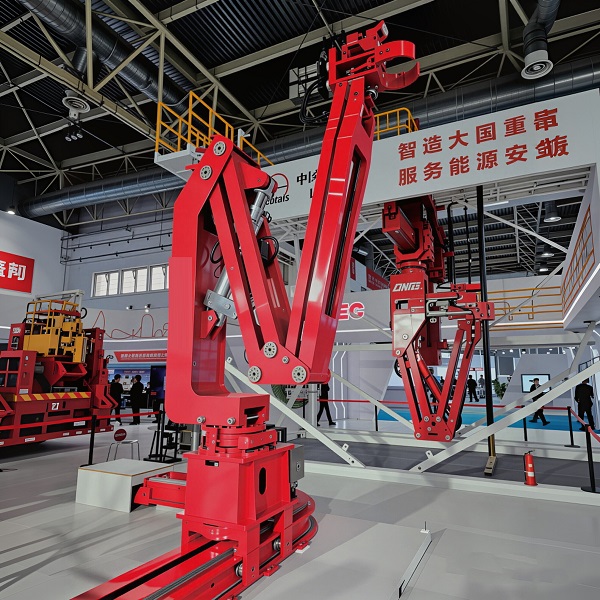
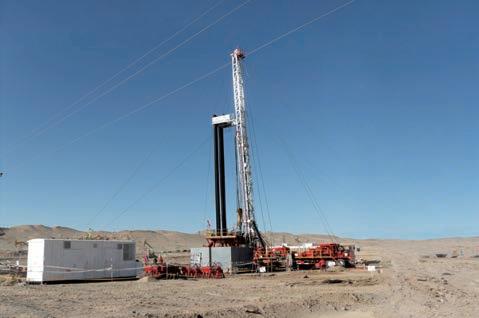
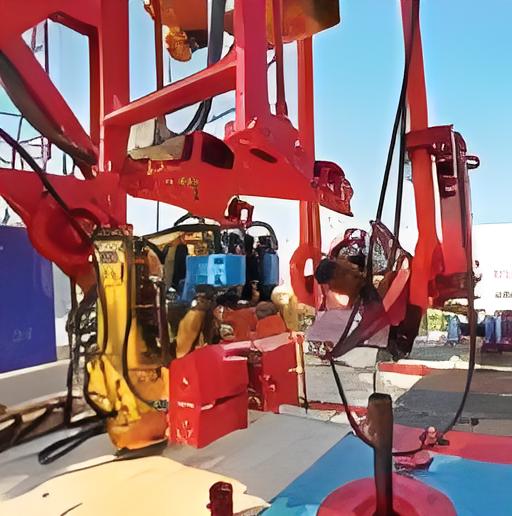
Drill floor operation robot
Technical Specifications
Drill Floor Operation Robot — Standard Model
| Parameter | Specification |
|---|---|
| Rated payload | 1,500 kg (with tool) / 2,000 kg (without tool) |
| Degrees of freedom | 6 axes |
| Maximum reach | 2,800 mm (horizontal) / 4,000 mm (vertical) |
| Repeatability | ±0.3 mm |
| Maximum linear speed | 1.8 m/s |
| Maximum angular speed | 180°/s |
| Torque control range (make/break) | 0 – 50,000 Nm |
| Spindle speed (spinner) | 0 – 80 RPM |
| Pipe OD range (gripper standard) | 2-3/8″ – 9-5/8″ (optional up to 13-3/8″) |
| Drill collar / BHA range | 4-1/2″ – 11″ |
| Thread compound reservoir | 20 liters (2 x 5‑gallon) |
| Mud bucket capacity | 25 liters |
| Power supply | 380V / 480V AC, 3‑phase, 50/60 Hz |
| Installed power | 35 kW (peak) / 15 kW (continuous) |
| Control system | Siemens / Beckhoff PLC + robot controller |
| Communication protocols | Modbus TCP, Profinet, EtherNet/IP |
| Protection class | IP65 (arm), IP54 (controller) |
| Explosion protection | ATEX Zone 1/2, IECEx, Class I Div 1/2 (optional) |
| Operating temperature | Standard: –20°C to +50°C; Arctic: –45°C |
| Certifications | API 7K / 8C, ISO 10218 (robot safety), CE |
| Weight (complete system) | ~6,500 kg (arm + base + controller + accessories) |
| Warranty | 18 months from shipment or 12 months from commissioning |
End‑Effector Tools (Exchangeable)
| Tool | Function | Specifications |
|---|---|---|
| Multi‑size gripper | Clamp and hold pipe | Interchangeable jaws for 2-7/8″ to 9-5/8″ |
| Spinner | Spin in/out pipe threads | Hydraulic/electric, up to 80 RPM |
| Torque wrench | Make/break final torque | Up to 50,000 Nm, ±2% accuracy |
| Automatic doper | Apply thread compound | Flow‑controlled, contactless nozzle |
| Mud bucket | Catch mud from box connection | Pneumatic closure, 25L capacity |
| Slip / elevator actuator | Engage/disengage slips | Integrated control signal to rig’s slip system |
Product Types — Drill Floor Operation Robots
| Model | Primary Application | Key Feature |
|---|---|---|
| DFR-800 | Small land rigs, workover rigs | 800 kg payload, compact footprint |
| DFR-1500 | Standard land rigs (ZJ40–ZJ70) | 1,500 kg payload, full 6‑axis, most popular |
| DFR-2500 | Heavy‑duty land rigs (ZJ70–ZJ90) | 2,500 kg payload, dual gripper, heavy casing |
| DFR-OS | Offshore platform / jack‑up | Marine coating, DNV/ABS certification, ATEX‑rated |
| DFR-ART | Arctic / low‑temperature rigs | Heated arm, –45°C components, special lubricants |
| DFR-AI | Full autonomous pad rigs | AI optimization, machine learning, predictive maintenance |
Additional configurations:
-
Single‑arm system — One robot handles all drill floor tasks
-
Dual‑arm system — Two robots working in coordination (e.g., one handling pipe, one making connection)
-
Mobile chassis — Robot mounted on rails or wheels to move between multiple well centers on a pad
Applications — Where Our Robot Delivers Maximum Value
| Operation | Without Robot | With Robot | Benefit |
|---|---|---|---|
| Making a connection | 2‑3 floor hands exposed to red zone; 4‑5 min per connection | 1 operator remote; 2‑2.5 min per connection | 50% faster, 90% less exposure |
| Stand building (offline) | Manual handling, separate crew; high fatigue | Robot builds stands offline while drilling continues | 20‑30% more rig time drilling |
| Tripping out (breaking connections) | Hands operating tongs, spinning out, doping threads; high strain | Robot performs all steps automatically | Consistent torque, zero dropped pipes |
| BHA assembly | High risk due to heavy components (drill collars, stabilizers) | Robot precisely handles heavy BHA tools | Eliminates back injuries, precise makeup |
| Night shift / reduced crew | Crew fatigue leads to errors, slower cycles | Robot performs same regardless of time of day | Consistent speed 24/7 |
| High‑H2S / toxic wells | Extra PPE, evacuation risk if leak occurs | Robot operates remotely; no human exposure | Lives saved, operations continue |
| Offshore platform | Cramped space, high consequence of dropped object | Compact robot, remote operation from cabin | Crew out of harm's way |
| Multi‑well pad (walking rig) | Same crew repeats same motions 100+ times — cumulative fatigue | Robot repeats perfectly every time | Zero fatigue‑related errors |
Real‑world result: In Russia's Gazprom Neft deployment, a robotic drilling system (including drill floor robot and pipe handler) increased well construction speed by 33% while performing all tubular make‑up/break‑out, running, and lifting operations without human participation.
Why Choose SJ Petro for Your Drill Floor Operation Robot?
1. Designed by Drilling Engineers — Not Factory Engineers
Our robot control logic was developed in partnership with Sinopec's own drilling crews. Every motion sequence, every torque curve, and every safety interlock has been validated on actual rigs in China’s toughest basins — from the Sichuan shale gas fields to the deep wells of the Tarim Basin. We know what works and what doesn't because we were there.
2. One‑Button Multi‑Machine Coordination
Our control system can orchestrate the entire drill floor automation suite: power catwalk, drill floor robot, monkeyboard robot, iron roughneck, slips, and mud pump sequencing. With a single button press, the operator can execute a complete trip cycle — from pipe pickup to connection to lowering — with no intermediate manual steps. This is the "iApex”‑style one‑key linkage that is setting new industry benchmarks.
3. Easy Integration with Existing Rigs
Our robot is designed to be retrofitted onto any existing rig — not just new builds. The base plate bolts to the rig floor structure (or a concrete foundation). The controller cabinet fits in a doghouse or in the driller's cabin. Integration with your existing iron roughneck, top drive, and BOP controls is typically completed in 5–7 days. You don't need a brand‑new rig to get a fully automated drill floor.
4. Built to API 7K / 8C and ISO 10218 (Robot Safety)
Our robots meet:
-
API 7K / 8C — Drilling equipment standards
-
API Q1 — Quality management
-
ISO 10218 — Robots and robotic devices safety requirements
-
ISO 13849 — Safety of machinery (PLr = e, SIL 2 capable)
-
ATEX / IECEx — Explosive atmospheres (Zone 1 and Zone 2)
-
ABS / DNV — Offshore marine certification (optional)
Third‑party witnessing (SGS, BV, DNV) is available at every stage of manufacturing.
5. Global Service & Spare Parts Support
-
Regional support hubs — Dubai (Middle East), Houston (Americas), Singapore (Asia‑Pacific)
-
24/7 remote diagnostics — Our engineers can log into the robot controller (with your permission) to troubleshoot and adjust parameters
-
Critical spares inventory — Joints, cables, grips, sensors, and controllers stocked for rapid air freight
-
On‑site commissioning & training — Included with every system
6. Backed by Sinopec — The World's Largest Energy & Chemicals Company
As a wholly‑owned subsidiary of Sinopec Oilfield Equipment Corporation, we are part of a Fortune Global 500 enterprise with decades of operating experience. Our equipment is not "prototype” technology — it has been refined through thousands of field applications. When you buy our drill floor operation robot, you are buying proven, bankable technology.
7. Flexible Commercial Options
-
Outright purchase — Standard 30/40/30 payment terms
-
Leasing — Operating lease (12–60 months) through Sinopec’s financial partners
-
Rent‑to‑own — Monthly payments with ownership transfer at term end
-
Trial deployment — 3‑month rental with full support; option to purchase afterwards
FAQ — Drill Floor Operation Robot
Q1: What is the typical payback period for a drill floor operation robot?
A: Based on field data from rigs that have automated their drill floors, payback is typically 6–18 months, depending on labor costs, rig utilization, and safety incident history. The robot reduces crew required on the drill floor by 2–3 people per shift, eliminates dropped‑object and struck‑by incidents, and shortens connection times by 30‑50%. For a rig making 50+ connections per day, the annual labor + productivity saving alone exceeds $300,000.
Q2: Can the robot handle different types of pipes — drill pipe, casing, drill collars — without manual changeover?
A: Yes. The gripper features interchangeable jaws that can be swapped in under 5 minutes. For routine pipe size changes (e.g., 3‑1/2″ drill pipe to 5″), the robot uses vision‑guided adaptive gripping — no parts change required. For drastic size changes (e.g., drill pipe to 9‑5/8″ casing), the operator selects the new size from the HMI, and the system prompts for jaw replacement.
Q3: Does the robot work with my existing iron roughneck and top drive?
A: Yes. We integrate the robot with your existing third‑party tools via digital I/O or fieldbus communication (Modbus, Profinet, EtherNet/IP). The robot can call the iron roughneck to make the final torque, or the top drive to spin, as needed. For maximum automation, we recommend pairing the robot with our own iron roughneck or top drive, but compatibility with major brands (NOV, Cameron, Schlumberger, etc.) is standard.
Q4: What happens if the robot encounters an unexpected obstacle or a pipe is misaligned?
A: The robot is equipped with collision detection via torque sensors in each joint. If it hits an unexpected force, it stops immediately and alarms. The vision system also constantly scans the workspace; if a person or obstacle enters the red zone while the robot is moving, the robot automatically pauses until the area is clear (light curtain option). The operator can override and move the robot in manual mode for recovery.
Q5: How long does it take to install the robot on an existing rig?
A: Installation typically takes 5–10 days depending on the complexity of the rig floor layout. Work includes: mounting the base plate, routing power and communication cables, installing the controller cabinet, calibrating sensors, and testing all functions. We work during planned rig maintenance periods or between wells to avoid production disruption.
Q6: What training do you provide for our crews?
A: We provide a 5‑day training program at your site:
-
Day 1–2: Classroom — safety, robot theory, control system operation, emergency procedures
-
Day 3–4: Hands‑on — dry runs of all cycles (pipe pickup, connection making, tripping, BHA handling)
-
Day 5: Live operations — supervised drilling/tripping with your crew operating
-
Optional: Advanced training (2 days) for maintenance technicians (PLC logic, sensor calibration, diagnostics)
We also provide a full simulator for ongoing training and certification.
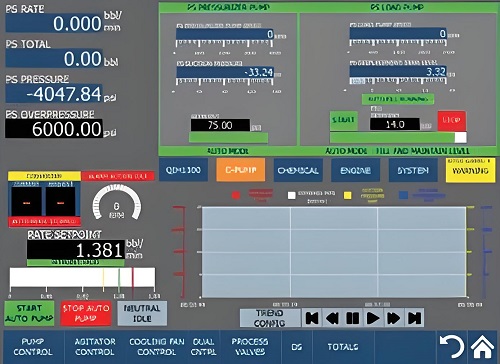
Q7: Do you offer a remote monitoring and analytics dashboard?
A: Yes. Our optional FleetView dashboard provides:
-
Real‑time robot status (position, torque, cycle count) from all rigs in your fleet
-
Historical performance analytics (average cycle time, uptime, torque deviations)
-
Predictive maintenance alerts (joint wear, actuator life remaining)
-
Incident logging (overloads, alarms, manual overrides)
Accessible via any web browser; customizable reporting.
Q8: Can the robot be operated in harsh weather — extreme heat, cold, dust, or salt spray?
A: Yes. The robot is rated for –20°C to +50°C standard. For extreme environments, we offer:
-
Desert package — sand‑resistant seals, oversized cooling, IP66 protection
-
Arctic package — heated arm, low‑temperature lubricants, –45°C rating
-
Offshore package — marine‑grade coatings, stainless steel fasteners, ATEX Zone 2 rating, DNV type approval
-
Tropical package — condensation‑resistant electronics, mold‑resistant cables
Tell us your location, and we will supply the appropriate configuration.







