Drill Floor Manipulator / Robot
Technical Specifications
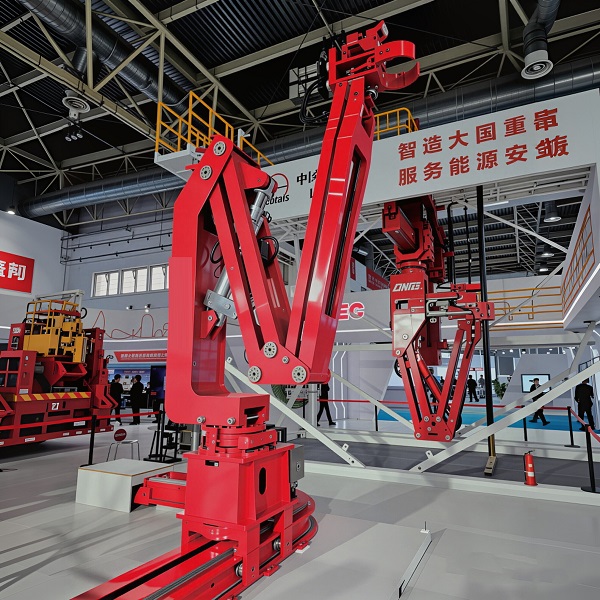
Manipulator Arm
| Parameter | Standard | Heavy Duty | Offshore |
|---|---|---|---|
| Payload (incl. tool) | 1,000 kg | 1,800 kg | 1,200 kg |
| Reach – horizontal | 2,500 mm | 2,800 mm | 2,500 mm |
| Reach – vertical | 3,800 mm | 4,200 mm | 3,800 mm |
| Degrees of freedom | 6 (articulated) | 6 | 6 |
| Repeatability | ±0.5 mm | ±0.5 mm | ±0.5 mm |
| Max linear speed | 1.5 m/s | 1.2 m/s | 1.5 m/s |
| Protection class | IP65 (arm) | IP65 | IP66 (marine washdown) |
| Operating temp | -20°C to +50°C | -30°C to +50°C | -20°C to +45°C |
| Power consumption | 12 kW cont., 28 kW peak | 18 kW cont., 35 kW peak | 12 kW cont., 28 kW peak |
| Weight (arm + base) | 2,800 kg | 3,600 kg | 3,100 kg |
Controller & Software
| Parameter | Specification |
|---|---|
| Controller type | Industrial PC + real‑time kernel |
| Programming languages | Drag‑and‑drop workflow (graphical) + Script (Python-like) |
| Offline simulation | 3D CAD import, collision detection, cycle time estimation |
| Communication | Modbus TCP, Profinet, EtherNet/IP, OPC UA |
| Vision system | Dual stereo cameras (1.2 MP each), LED lighting, AI object recognition |
| Safety certification | ISO 10218, ISO 13849 (PLr = e, SIL 2) |
| Electrical supply | 400V/480V AC, 3‑phase, 50/60 Hz, 70A max |
| Cabinet dimensions | 1,200 × 600 × 2,000 mm (floor standing) |
Interchangeable Tool Specifications (Examples)
| Tool | Function | Weight | Drive | Connection |
|---|---|---|---|---|
| Parallel gripper (2-7/8″–7″) | Pipe handling | 85 kg | Electric servo | Quick‑change |
| Large gripper (7″–13-3/8″) | Casing / large pipe | 120 kg | Electric servo | Quick‑change |
| Spinner | Thread spinning | 95 kg | Hydraulic (5,000 psi) | Quick‑change + hose coupler |
| Torque wrench | Make/break final torque | 210 kg | Hydraulic (50,000 Nm) | Quick‑change + hose coupler |
| Thread doper | Apply compound | 30 kg | Pneumatic | Quick‑change |
| Bolt torque tool (1-1/8″ to 2-1/2″) | BOP / wellhead bolts | 65 kg | Electric | Quick‑change |
| Vacuum pad | Handle flat objects (e.g., mud bucket) | 15 kg | Pneumatic | Quick‑change |
| Camera / inspection arm | Visual check of threads, BOP seals | 8 kg | Electric | Quick‑change |
Product Types – Manipulator / Robot Configurations
| Model | Payload | Reach | Typical Use | Key Feature |
|---|---|---|---|---|
| MF-1000 | 1,000 kg | 2.5 m / 3.8 m | Standard land rigs (ZJ30–ZJ50) | Best price/performance |
| MF-1800 | 1,800 kg | 2.8 m / 4.2 m | Heavy land rigs (ZJ70–ZJ90) | Drill collar, heavy casing, BOP handling |
| MF-OS | 1,200 kg | 2.5 m / 3.8 m | Offshore platform / jack‑up | Marine coating, ATEX, DNV |
| MF-AR | 1,000 kg | 2.5 m / 3.8 m | Arctic / cold climate | -45°C rating, heated arm |
| MF-DUAL | 2 x 1,000 kg | (tandem) | Fully automated pad rigs | Two arms working coordinated |
Retrofit kit for manual manipulators: If you already have a hydraulic manipulator (e.g., a simple pipe handler), we can convert it to a fully programmable electric robot with new controllers, sensors, and software. Typically 50‑60% of the cost of a new arm.
Applications – Beyond Pipe Handling
| Task | Traditional Method | With Manipulator | Safety & Productivity Gain |
|---|---|---|---|
| Making/breaking connections | 2‑3 floor hands with tongs & spinner | One robot + remote operator | 50% faster, eliminates muscle strain & pinch points |
| BOP bolt tightening | Technician with hydraulic torque wrench, exposed to fall hazard | Robot with bolt torque tool, operated from cabin | Eliminates fall risk, consistent torque (no under/over) |
| Mousehole operations | Floor hand manually stabs pipe, operates slips | Robot holds pipe, aligns thread, activates slips | Zero hand‑in‑mousehole, 1‑person operation |
| Tool & part delivery | Crew carries drill collars, subs, bits across floor | Robot lifts & carries heavy items | Eliminates back injuries, dropped object risk |
| Thread cleaning & doping | Manual wire brush and dope rag | Robot with integrated brush + doper | Consistent cleaning, no chemical exposure |
| Pipe racking (fingerboard) | Crown man on platform guides pipe | Robot with vision aligns pipe | No man up in the derrick |
| Slip handling | Manual lift of heavy slips (20‑40 kg each) | Robot picks & places slips | Eliminates back strain |
| Wellhead / X‑mas tree installation | Crane + tag lines, crew on platform | Robot with guided bolt tool | Precise alignment, remote control |
Why Choose SJ Petro for Your Drill Floor Manipulator / Robot?
1. Designed for Retrofits, Not Just New Rigs
Most robotic systems are designed for brand‑new automated rigs with unlimited budget and space. Ours is purpose‑built to bolt onto existing rigs – even old mechanical rigs with no VFD. We have retrofitted units onto rigs built in the 1980s. The base plate uses existing bolt holes where possible; otherwise, we provide a small concrete foundation (1.5m × 1.5m).
2. One Robot, Dozens of Tools – Save Capital Expense
Instead of buying a dedicated pipe handler, a dedicated BOP bolt tool, and a dedicated mousehole robot, you buy one manipulator and a set of tools. Total investment is 50‑70% lower than buying multiple specialized machines.
3. Red Zone Removal – Measurable Safety ROI
We provide a pre‑installation safety risk assessment and a post‑installation incident reduction report. Typical results: 85‑90% reduction in crew time spent in the red zone, and a 70% drop in floor‑hand musculoskeletal injuries. Many of our customers have used the robot to justify lower insurance premiums.
4. Backed by Sinopec’s Automation R&D
Our control software and AI vision models are co‑developed with Sinopec’s central research institute. We have access to hundreds of thousands of hours of real‑world drilling footage, used to train the robot’s object recognition. No other independent supplier has this depth of field data.
5. Open Interface – No Vendor Lock‑In
We provide the robot’s motion API (C++ and Python libraries). You or your automation integrator can write custom routines – for example, to adapt to a proprietary well control sequence. We also share the diagnostic data format; you can feed it into your own maintenance system.
6. Global Service & Fast Spares
-
24/7 remote support – Our engineers can log in (with your permission) to diagnose software issues, adjust safety zones, or replay fault logs.
-
Regional spare hubs – Dubai, Houston, Singapore stock manipulator joints, tool adapters, gripper pads, and controllers.
-
Field service – On‑site commissioning, repairs, and training included with purchase; fee‑based after warranty.
7. Flexible Ownership Models
| Option | Description |
|---|---|
| Purchase | 30/40/30 payment, 18‑month warranty |
| Lease | 12–60 months operating lease; maintenance included |
| Rent‑to‑own | Monthly payments, ownership after 24 months |
| Robotics‑as‑a‑Service (RaaS) | Pay per hour of operation (min. 500 hrs/month) – ideal for short campaigns |
FAQ – Drill Floor Manipulator / Robot
Q1: Can your manipulator work on a rig that already has an iron roughneck and a catwalk?
A: Absolutely. The manipulator is not designed to replace existing equipment unless you want it to. It can assist – for example, the iron roughneck makes the final torque, while the manipulator holds the pipe and aligns the thread. Or it can take over the spinner function, leaving the roughneck only for final torque. We integrate via digital I/O so they sequence safely.
Q2: How long does it take to change from one tool to another?
A: Less than 2 minutes for a trained operator. The quick‑change adapter uses a mechanical lock and a single electrical/hydraulic coupling (self‑sealing). The robot automatically reads the tool ID and loads the correct motion parameters (speed, torque limits, etc.).
Q3: What happens if the robot hits a person? Does it have force limiting?
A: Yes. The robot is certified to ISO 10218 for collaborative operation. Each joint has torque sensors; if the robot contacts an object with force above the configurable threshold (default 150 N), it stops within 50 ms. Additionally, the laser scanner can detect a person entering the red zone and slow the robot to a "safe speed” (0.25 m/s) or stop it completely. The operator can also press a dead‑man switch on the pendant to enable motion only while held.
Q4: Can I use your robot on a jack‑up or semi‑sub offshore?
A: Yes. The OS version has marine coatings, IP66 protection (washdown), ATEX Zone 2 electricals, and optional DNV type approval. The arm is designed to handle motion compensation input – the control system can be slaved to the rig’s heave signal to keep the tool steady relative to the wellhead.
Q5: Do I need a full‑time robot programmer on site?
A: Not at all. The system ships with a library of pre‑programmed cycles: make connection, break connection, stand building, BOP bolt torque, mousehole stabbing, slip placement, etc. The driller selects the cycle from a touchscreen. For custom tasks (e.g., a unique BOP size), our offline programming software allows an engineer to create a new sequence in the office and upload it. Most rigs never need a dedicated programmer.
Q6: What about power supply – my rig is old and has limited capacity.
A: The manipulator requires 400V/480V AC, 70A peak (for 1,000 kg model). If your rig’s generator set cannot provide the peak, we offer a power buffer module – a small battery/ultracapacitor that absorbs the peak and recharges slowly. This works on rigs with as little as 30A spare capacity. We also have a pneumatic‑over‑hydraulic option for rigs with no significant electrical spare – less efficient but uses rig air.
Q7: How do you ensure the manipulator does not interfere with other automated equipment (catwalk, iron roughneck)?
A: We perform a collision simulation before installation using your rig’s 3D model (or we laser‑scan the rig floor). The robot’s work envelope is defined and hard‑coded into the controller. Additionally, other equipment sends "busy” signals to the manipulator; it will not move into a zone that is occupied.
Q8: What is the typical time to break even on this investment?
A: Based on case studies from our Middle East and China customers, the payback period ranges from 8 to 14 months when considering:
-
Labor savings (2 floor hands replaced across 3 shifts = 6 fewer personnel per rig)
-
Reduced connection time (30‑50% faster)
-
Eliminated injury costs (one serious back injury averages $150,000)
-
Lower thread damage (from consistent torque)
We can provide a confidential ROI projection based on your specific daily rate and crew cost.