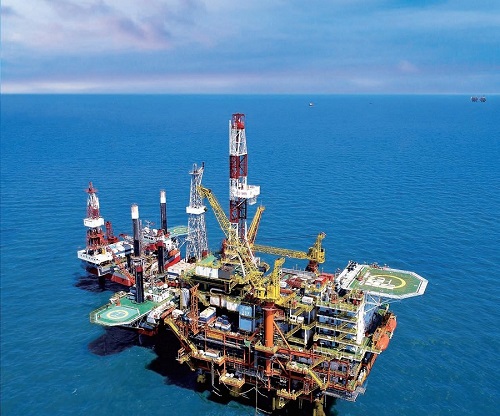
Technical Specifications (Standard Jack‑Up Drilling Rig – 90 m water depth)
Below is a typical specification for a 300‑ft (90 m) independent leg jack‑up.
|
Parameter
|
Specification
|
|
Water Depth (Operating)
|
15 – 90 m (50 – 300 ft)
|
|
Max Hook Load
|
4,500 kN (1,000,000 lbs)
|
|
Drilling Depth (5″ DP)
|
7,000 m (23,000 ft)
|
|
Workover Depth (3‑1/2″ tubing)
|
9,000 m (29,500 ft)
|
|
Derrick / Mast
|
49 m (160 ft), 5,000 kN static capacity
|
|
Drawworks
|
3,000 HP AC VFD, single drum
|
|
Top Drive
|
1,000 HP, 0–220 RPM, 40,000 Nm torque
|
|
Rotary Table
|
37‑1/2″ (952 mm)
|
|
Cantilever Skidding – Lateral
|
± 7.5 m (total 15 m)
|
|
Cantilever Skidding – Longitudinal
|
12 m (extend over bow)
|
|
Mud Pumps
|
2× 2,200 HP triplex, 7,500 psi
|
|
Mud Pit Capacity
|
2,000 bbl (318 m³)
|
|
Bulk Storage (Cement, Barite)
|
400 m³ (14,100 cu ft)
|
|
BOP Stack
|
18‑3/4″, 15,000 psi (or 13‑5/8″), dual ram + annular
|
|
Leg Type
|
Truss, 3 legs (158 m length, 10 m chord spacing)
|
|
Leg Jacking Speed
|
0.9 m/min (loaded) / 1.8 m/min (unloaded)
|
|
Hull Dimensions (L×W×D)
|
70 m × 70 m × 8 m (triangular or rectangular)
|
|
Variable Deck Load
|
2,500 tonnes (operating) / 3,500 tonnes (transit)
|
|
Accommodations
|
120 persons (single/double cabins)
|
|
Helideck
|
24 m diameter, S‑92 capable
|
|
Power Generation
|
5× 2,500 kW diesel generators
|
|
Class
|
ABS (or DNV, CCS optional)
|
|
Design Life
|
25 years
|
Application Fields
Jack‑up rigs are used worldwide in shallow to moderate water depths.
-
Middle East Gulf (Arabian Gulf)
Water depths 20–60 m, sand seabed. Jack‑ups drill new wells from artificial islands or platform wellbays. Our rigs are active in Saudi Arabia, UAE, and Qatar fields – equipped with dust protection and air conditioning for 50°C ambient.
-
[Image Placeholder: Jack‑up rig operating in Middle East waters with cantilever over platform]
Southeast Asia (Indonesia, Malaysia, Thailand, Vietnam)
Mature fields require frequent workover. Our light workover jack‑up (smaller, cheaper) is popular – it moves from platform to platform performing tubing changes, plug milling, and zone isolations.
-
North Sea (Southern sector)
Water depths 30–70 m, harsh weather (significant wave height 12 m). Our high‑spec jack‑ups have strengthened hulls, winterized accommodations, and ice‑class legs. They operate year‑round.
-
West Africa (Nigeria, Angola, Ghana)
Shallow water (20–40 m) but soft seabed (clay, silt). Our leg spud‑cans are oversized (150 m²) to reduce bearing pressure. Preload monitoring is critical – we include extensive seabed sensors.
-
China Bohai Bay & South China Sea
Shallow offshore fields use jack‑ups for both drilling and workover. Some rigs are designed to operate on existing fixed platforms (cantilever access to platform wellbay). We have delivered 12 jack‑ups to Chinese operators since 2010.
-
Wind Farm Installation & Support
Jack‑up rigs are increasingly used as staging platforms for offshore wind turbine installation and cable laying. Our heavy‑lift jack‑ups (with large cranes) are used in this growing market – ask for our "renewables” configuration.
Why Choose SJ Petroleum Machinery for Jack‑Up Rigs?
1. Integrated In‑House Engineering
We do not outsource critical systems. Our team designs the hull, legs, jacking system, cantilever, and drilling package as an integrated unit – no compatibility problems. We also provide full naval architecture and stability analysis.
2. Proven Cantilever Performance
Our cantilever system uses high‑strength steel box beams with hydraulic skidding cylinders. We have tested at 125% of rated load with 12 m extension. The skidding system has a mean time between failures (MTBF) of 5,000 hours – backed by field data.
3. Fast Jacking & Leg Handling
Time spent jacking up or down is non‑productive. Our jacking system uses multiple high‑torque motors (8 per leg) and a PLC‑controlled synchronizer. Jacking speed 0.9 m/min under full preload – 30% faster than many competitors.
4. Safety by Design
Every jack‑up includes:
– Redundant leg brakes (spring‑applied, hydraulic release)
– Real‑time leg load monitoring with audible alarm
– Punch‑through prediction software (using seabed CPT data)
– Automatic ballast control system
– Drift‑off warning (if rig moves off location)
Our rigs meet or exceed ABS MODU rules.
5. Global Service Network
We have service hubs in Houston (Americas), Dubai (Middle East), Singapore (Asia‑Pacific), and Jingzhou (China). We supply spare parts (jack pinions, brake pads, seals, valves) and can send field service teams for major repairs or upgrades anywhere in the world.
6. Competitive Delivery & Price
As a Sinopec subsidiary, we combine Chinese shipyard efficiency with international quality standards. Our standard jack‑up rigs are typically 15–20% lower in capital cost than equivalent European or Asian competitors, with similar lead times (30–36 months).
Frequently Asked Questions (FAQ)
Q1: How deep can a jack‑up rig operate?
The practical limit is about 120 meters (400 ft) for drilling rigs. Beyond that, leg length becomes very long (150+ m), and the rig becomes unstable. For deeper water, you need a semisubmersible or drillship.
Q2: How does a jack‑up rig move from one location to another?
The rig floats (it is buoyant). After raising legs fully, tugboats tow the rig at 4–6 knots to the next location. For longer moves (e.g., across oceans), the rig can be loaded onto a heavy‑lift vessel. Our rigs are designed for ocean towing in moderate sea states (significant wave height < 3 m).
Q3: What is the risk of leg "punch‑through”?
Punch‑through occurs when the leg spud‑can suddenly penetrates a soft layer into a weaker layer below. We mitigate with: (1) preloading (jacking the rig to 120% of operating load before drilling), (2) seabed surveys (CPT cone penetration tests), and (3) real‑time leg load monitoring. If punch‑through occurs, our jacking system automatically jacks down to arrest penetration.
Q4: Can your jack‑up rig workover a well on an existing fixed platform?
Yes – the cantilever extension (12 m) reaches over the platform’s wellbay. The jack‑up positions itself adjacent to the platform (typically 5 m gap). Our rig’s BOP stack and riser connect to the platform’s wellhead. This is a common operation in mature fields.
Q5: How long does it take to jack the rig up to operating height?
For a 90 m water depth, legs are lowered to seabed (90 m travel) at 1.8 m/min unloaded – 50 minutes. Then jack hull up to air gap (say 15 m above water) at 0.9 m/min loaded – 17 minutes. Total ~1.5 hours. Preloading (applying extra load to seat legs) takes another 4–8 hours.
Q6: What is the typical crew size on a jack‑up rig?
Drilling mode: 80–100 persons (drillers, roughnecks, engineers, crane operators, galley, medics). Workover mode: 40–60 persons. Accommodations on our rigs typically house 120 persons.
Q7: Do you offer jack‑up rigs for sale or only for charter/lease?
We sell the rigs directly to operators or drilling contractors. We do not operate them – you provide your own crew. However, we can assist with financing and leasing through partner financial institutions.
Q8: What is the typical lead time for a newbuild jack‑up rig?
30–36 months from contract to delivery. This includes detailed design, steel cutting, hull and leg fabrication, outfitting, system integration, and commissioning. For a light workover jack‑up (simpler), 24 months.
Q9: Can the rig be upgraded later (e.g., deeper water, higher hook load)?
Water depth upgrade is difficult (requires longer legs). Hook load upgrade is possible by strengthening the derrick and drawworks – but it is expensive. We recommend specifying your maximum required depth and load upfront.
Q10: How do you ensure the rig is stable during jacking and drilling?
We provide a full stability booklet and ballast control plan. The hull has multiple watertight compartments, and we use a computer‑controlled ballast system to keep the rig level during jacking. The rig’s variable deck load (consumables, pipe, mud) is monitored, and weight distribution is adjusted to avoid exceeding leg bearing capacity.
Tag: Digital rig price | Desert rig price | Quick install drilling solutions | Desert drilling technology | Desert drilling solutions | Latest drilling technology